Social Impact Measurement: Frameworks for Non-Profits in 2026

In an increasingly complex world, non-profit organizations are under greater scrutiny than ever before to demonstrate their effectiveness and the tangible difference they make. Simply doing good is no longer enough; proving that good is being done, and understanding how, is paramount. This is where social impact measurement comes into play. For non-profits navigating the landscape of 2026, selecting the right framework for social impact measurement is not just a best practice, but a strategic imperative for securing funding, building trust, and continuously improving their programs.
The ability to effectively measure, evaluate, and communicate social impact empowers organizations to articulate their value proposition to donors, beneficiaries, and stakeholders. It allows for data-driven decision-making, ensuring resources are allocated efficiently to achieve the greatest possible positive change. Without robust social impact measurement, organizations risk operating in a vacuum, unable to truly understand or maximize their contribution to society.
This comprehensive guide delves into four leading social impact measurement frameworks that are particularly relevant for non-profits in 2026: Social Return on Investment (SROI), IRIS+, the Global Impact Investing Network (GIIN) Impact Measurement & Management (IMM) framework, and the Theory of Change. We will explore each framework in detail, comparing their methodologies, benefits, challenges, and providing insights into how non-profits can effectively implement them to strengthen their impact narrative and operational efficiency.
Understanding the Imperative of Social Impact Measurement for Non-Profits
Before diving into specific frameworks, it’s crucial to grasp why social impact measurement has become such a cornerstone of non-profit operations. In an era of heightened accountability and competition for limited funding, organizations must demonstrate not only their activities but also the profound effects of those activities on individuals, communities, and the environment. Donors, foundations, and government agencies are increasingly sophisticated, demanding evidence of impact rather than just anecdotal success stories.
Beyond external pressures, effective social impact measurement offers significant internal benefits. It fosters a culture of learning and continuous improvement, allowing organizations to identify what works, what doesn’t, and why. This understanding enables program adjustments, leading to more impactful interventions and better resource utilization. It also empowers staff by providing clear metrics of success and a deeper connection to the organization’s mission.
The landscape of 2026 sees an increased emphasis on standardized metrics and transparent reporting. The rise of impact investing and ESG (Environmental, Social, and Governance) criteria means that non-profits are often evaluated alongside for-profit entities, requiring a sophisticated approach to articulating social value. Therefore, mastering a relevant social impact measurement framework is no longer optional but essential for long-term sustainability and growth.
Framework 1: Social Return on Investment (SROI)
What is SROI?
Social Return on Investment (SROI) is a principles-based framework for measuring and accounting for a broad concept of value. It aims to put a monetary value on social, environmental, and economic outcomes that are not traditionally reflected in financial accounts. By assigning a financial proxy to these outcomes, SROI can demonstrate the value created by an organization relative to the investment made, typically expressed as a ratio (e.g., for every $1 invested, $X of social value is created).
Methodology and Key Principles
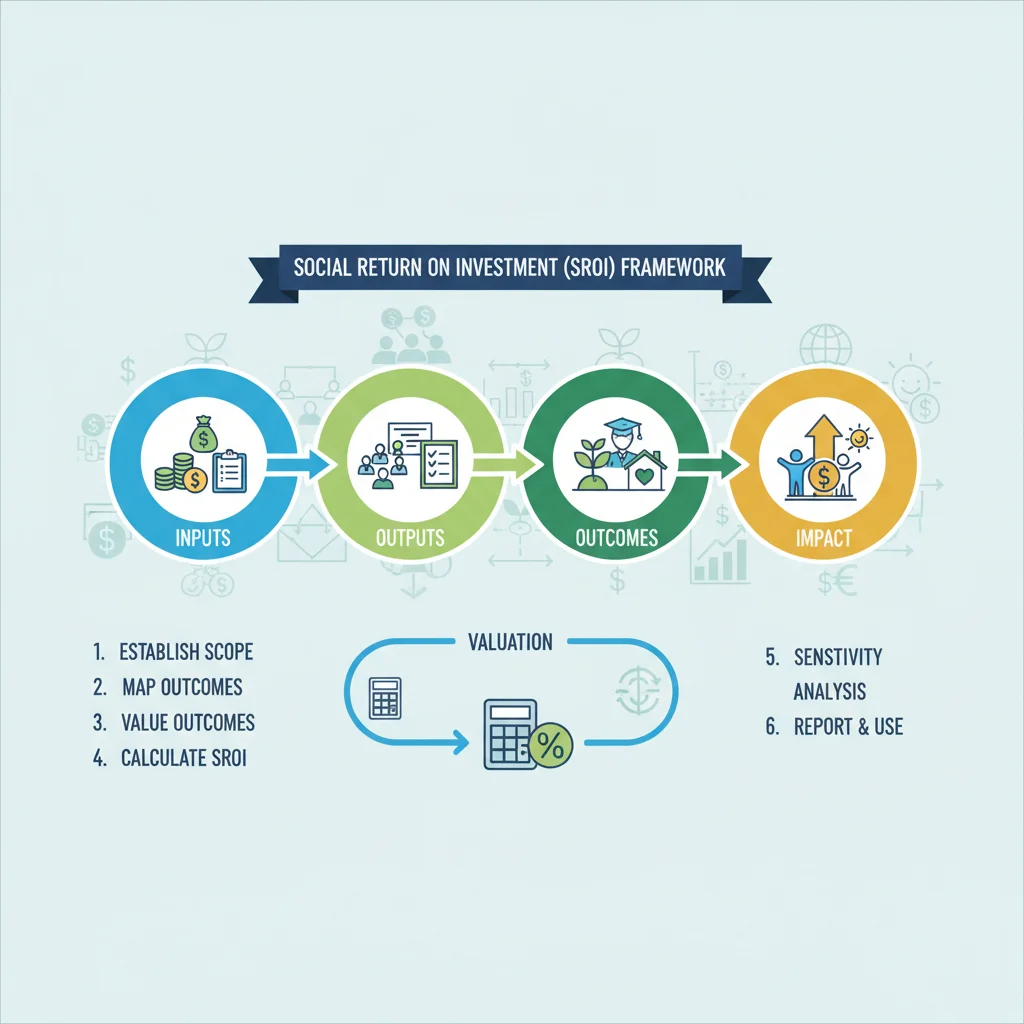
The SROI methodology involves several key stages:
- Establishing Scope: Identifying the key stakeholders and the social impact intended to be measured.
- Mapping Outcomes: Understanding how changes are created, using a Theory of Change or logic model to connect inputs to outputs, and then to outcomes and impact.
- Evidencing Outcomes and Valuing Them: Gathering qualitative and quantitative data to demonstrate outcomes. This is where financial proxies are assigned to non-market outcomes (e.g., the cost savings from reduced crime, the value of improved health).
- Establishing Impact: Ensuring that only the portion of the outcome directly attributable to the organization’s activities is counted, accounting for deadweight, attribution, displacement, and drop-off.
- Calculating SROI: Summing up all the monetized outcomes, subtracting the investment, and then calculating the ratio.
- Reporting, Using, and Embedding: Communicating the findings and using them for decision-making and continuous improvement.
SROI adheres to seven core principles: Involve Stakeholders, Understand What Changes, Value What Matters, Only Include What is Material, Do Not Overclaim, Be Transparent, and Verify the Result.
Benefits for Non-Profits
- Comprehensive Value: SROI provides a holistic view of value, incorporating social and environmental benefits alongside economic ones, making it a powerful tool for demonstrating the full breadth of an organization’s impact.
- Stakeholder Engagement: The process inherently involves stakeholders, fostering deeper understanding and collaboration.
- Decision-Making: The monetized ratio offers a clear metric that can inform strategic planning, resource allocation, and program design.
- Fundraising: A strong SROI report can be a compelling argument for funders, showcasing a clear return on their investment.
Challenges and Considerations
- Complexity and Resources: SROI can be resource-intensive, requiring significant time, expertise, and data collection capabilities.
- Monetization Difficulty: Assigning accurate financial proxies to social outcomes can be subjective and challenging, requiring careful justification.
- Data Intensity: It demands robust data collection and analysis to ensure credibility and accuracy.
Framework 2: IRIS+
What is IRIS+?
IRIS+ (Impact Reporting and Investment Standards) is a catalog of generally accepted performance metrics that are used to measure social, environmental, and financial performance. Developed by the Global Impact Investing Network (GIIN), IRIS+ provides a common language for describing, measuring, and reporting impact, primarily for impact investors and the enterprises they fund. While originally designed for impact investing, its standardized metrics are highly valuable for non-profits seeking to align with broader impact reporting standards and attract diverse funding sources.
Methodology and Key Components
IRIS+ is structured around:
- Core Metrics Sets: Curated sets of metrics for specific impact themes (e.g., affordable housing, clean energy, education) that help users get started quickly with relevant indicators.
- The IRIS+ Catalog: A comprehensive library of individual metrics, covering various dimensions of social and environmental performance.
- Guidance: Provides practical advice on how to use metrics, including definitions, calculation methodologies, and reporting best practices.
- Thematic Taxonomy: Organizes impact areas into a structured hierarchy, facilitating consistent categorization and analysis.
The goal of IRIS+ is to help organizations define their impact goals, identify relevant metrics, collect data, analyze performance, and report their results in a standardized way. It emphasizes materiality – focusing on the most important indicators for a given impact area.
Benefits for Non-Profits
- Standardization: Provides a globally recognized set of metrics, enhancing comparability and credibility across different organizations and sectors.
- Clarity and Focus: Helps non-profits select relevant indicators aligned with their mission and specific impact areas, reducing measurement ambiguity.
- Investor Alignment: Particularly useful for non-profits seeking funding from impact investors, as it speaks their language and streamlines reporting.
- Efficiency: Reduces the effort needed to develop custom metrics from scratch, offering a ready-to-use library.
Challenges and Considerations
- Scope: While comprehensive, IRIS+ primarily focuses on output and outcome metrics. It doesn’t inherently provide a framework for attributing impact or monetizing social value in the same way SROI does.
- Implementation Effort: Selecting and consistently tracking the appropriate metrics still requires internal capacity and data management systems.
- Adaptation: Non-profits may need to adapt or supplement IRIS+ metrics to fully capture the unique nuances of their specific programs and target populations.
Framework 3: Global Impact Investing Network (GIIN) Impact Measurement & Management (IMM) Framework
What is the GIIN IMM Framework?
The Global Impact Investing Network (GIIN) has been a pioneer in defining and promoting impact investing. Their Impact Measurement & Management (IMM) framework, while closely related to IRIS+, provides a broader strategic approach to managing impact throughout an organization’s lifecycle. It’s less about a specific set of metrics and more about a systematic process for integrating impact considerations into decision-making. For non-profits, adopting the GIIN IMM approach means embedding impact thinking into their organizational DNA.
Methodology and Key Components
The GIIN IMM framework outlines five core dimensions of impact that should be considered:
- What: What positive and negative outcomes does the enterprise contribute to?
- Who: Who experiences the outcomes? How underserved are they?
- How Much: How significant is the outcome? What is its scale, depth, and duration?
- Contribution: Would the outcome have happened anyway? What is the enterprise’s unique contribution?
- Risk: What is the risk that the impact will not occur as expected?
These dimensions guide organizations through a continuous cycle of setting impact goals, identifying relevant metrics (often using IRIS+), collecting and analyzing data, reporting on performance, and using insights for improvement. It emphasizes a structured approach to impact management, moving beyond just measurement to active management for better outcomes.
Benefits for Non-Profits
- Strategic Integration: Encourages non-profits to embed impact considerations into every aspect of their strategy, operations, and decision-making.
- Holistic View: The five dimensions provide a comprehensive lens through which to analyze and understand impact, going beyond simple output counting.
- Risk Management: Explicitly addresses impact risk, prompting organizations to anticipate and mitigate potential negative outcomes or failures to achieve intended impact.
- Credibility with Investors: Demonstrates a sophisticated understanding of impact, appealing to impact-first investors and partners.
Challenges and Considerations
- Conceptual Depth: Requires a deep understanding of impact theory and the ability to apply it strategically across the organization.
- Data Alignment: While it provides the framework, organizations still need to align their data collection with the five dimensions and relevant metrics.
- Cultural Shift: Implementing the GIIN IMM framework often requires a significant cultural shift within an organization to prioritize and integrate impact management at all levels.
Framework 4: Theory of Change
What is a Theory of Change?
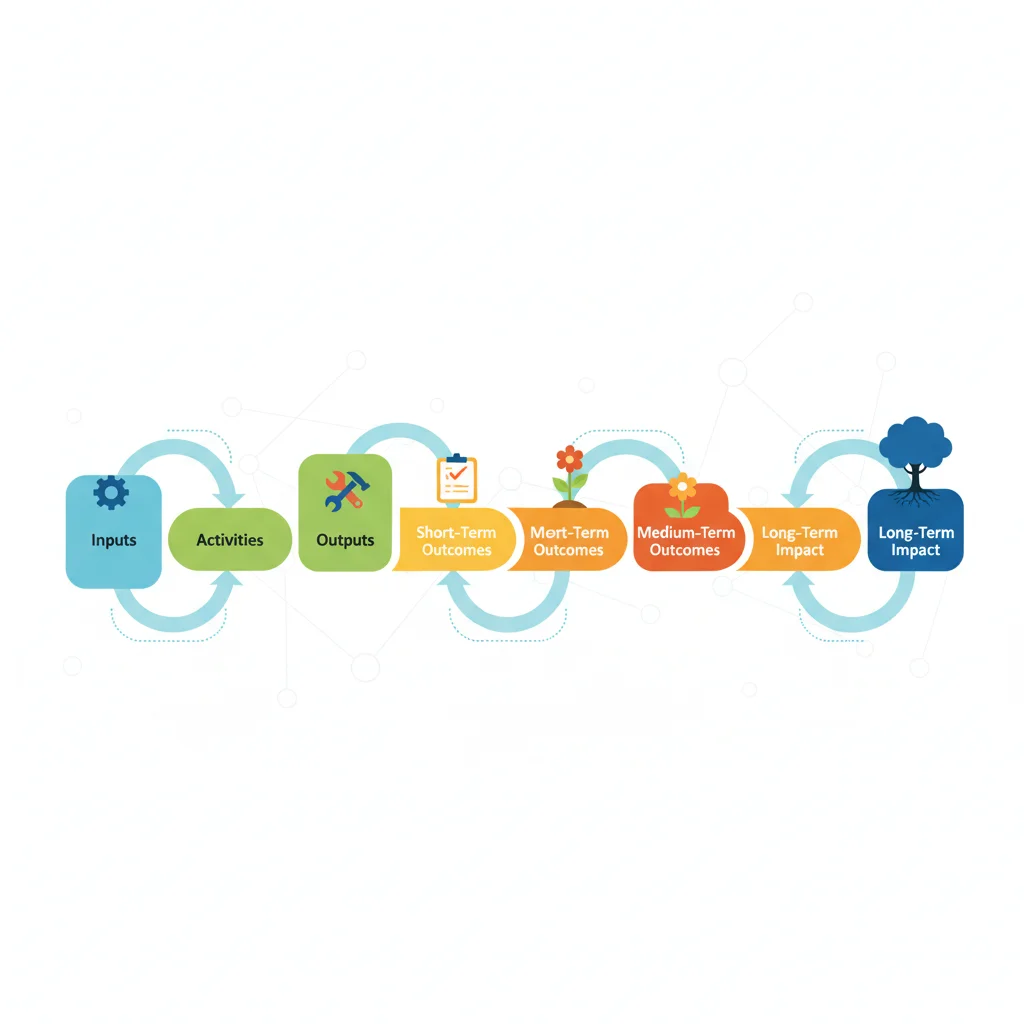
A Theory of Change (ToC) is a comprehensive description and illustration of how and why a desired change is expected to happen in a particular context. It is a rigorous, ongoing process of critical thinking about how an intervention (a project, program, policy, strategy, or initiative) contributes to a chain of results that lead to the desired impact. Unlike a simple logic model, a ToC explicitly details the underlying assumptions, preconditions, and causal pathways linking activities to long-term outcomes.
Methodology and Key Components
Developing a Theory of Change typically involves:
- Identifying Long-Term Goals: What is the ultimate impact the organization aims to achieve?
- Backward Mapping: Working backward from the long-term goals, identifying the preconditions that must be met for those goals to occur.
- Identifying Interventions: Determining what activities the organization will undertake to achieve these preconditions.
- Articulating Assumptions: Explicitly stating the beliefs and conditions that must hold true for the causal links to be valid.
- Developing Indicators: Identifying measurable indicators for each step in the causal pathway to track progress.
A ToC is often represented visually as a diagram or flow chart, making the complex causal relationships clear and understandable. It is a living document, meant to be reviewed and revised as learning occurs.
Benefits for Non-Profits
- Clarity and Focus: Provides a clear, shared understanding of how and why an organization’s work is expected to lead to desired changes, aligning internal and external stakeholders.
- Program Design: Strengthens program design by ensuring activities are logically linked to intended outcomes and impact.
- Evaluation Framework: Naturally forms the basis for evaluation, as it identifies the key points at which to measure progress and test assumptions.
- Learning and Adaptation: By explicitly stating assumptions, it allows for proactive learning and adaptation when those assumptions are challenged.
Challenges and Considerations
- Time and Expertise: Developing a robust ToC requires significant time, facilitation skills, and critical thinking.
- Complexity: For complex programs, the ToC can become intricate, requiring careful management to remain clear and usable.
- Over-simplification: There’s a risk of over-simplifying complex social issues or making assumptions that are not adequately tested.
Comparative Analysis: Choosing the Right Framework for Your Non-Profit
Each of these social impact measurement frameworks offers distinct strengths, and the ‘best’ choice for a non-profit in 2026 often depends on its specific goals, resources, stage of development, and stakeholder requirements. Here’s a comparative look:
SROI vs. IRIS+ vs. GIIN IMM vs. Theory of Change
- SROI (Social Return on Investment): Best for organizations that need to demonstrate a financial return on social investment, particularly when engaging with funders who require a clear monetary value of impact. It’s powerful for advocacy and compelling storytelling but is resource-intensive due to its monetization aspect. It answers the question, “What is the financial value of our social impact?”
- IRIS+: Ideal for non-profits that need standardized, comparable metrics, especially if they are seeking funding from impact investors or want to align with global reporting standards. It’s a comprehensive library of metrics but requires the organization to select and track them rigorously. It answers the question, “What are the key performance indicators of our social and environmental progress?”
- GIIN IMM Framework: Suited for organizations that want to integrate impact management deeply into their strategic decision-making and operational processes. It provides a holistic lens for understanding and managing impact across five dimensions, fostering a culture of continuous improvement. It answers the question, “How do we strategically manage and optimize our impact?”
- Theory of Change: A foundational tool that can complement any other framework. It is excellent for program design, evaluation planning, and building a shared understanding of how change happens. It’s crucial for organizations that need to articulate their impact logic clearly and test underlying assumptions. It answers the question, “How and why does our work lead to desired social change?”
Hybrid Approaches and Synergies
It’s important to note that these frameworks are not mutually exclusive; in fact, they often complement each other. Many non-profits find success in adopting a hybrid approach:
- A Theory of Change can serve as the foundational planning tool, clearly outlining the causal pathways and assumptions.
- Once the ToC is established, IRIS+ metrics can be selected to measure the indicators identified within the ToC’s outcomes.
- The GIIN IMM framework can then guide the overall strategic management of this impact data, ensuring it informs decision-making and risk assessment.
- For specific projects or when seeking particular funding, an SROI analysis can be conducted to translate the measured impact into a financial value.
For example, a non-profit focused on youth education might use a Theory of Change to map out how their tutoring programs lead to improved academic performance and future employment. They would then use IRIS+ metrics to track attendance, grades, and graduation rates. The GIIN IMM framework would help them continuously assess their contribution and manage risks, while an SROI analysis could be performed to demonstrate the economic value of increased earning potential for their beneficiaries.
Best Practices for Implementing Social Impact Measurement in 2026
Regardless of the framework chosen, successful social impact measurement hinges on several best practices:
- Start Small and Scale Up: Don’t try to measure everything at once. Begin with a pilot project or a few key outcomes, learn from the process, and then gradually expand your measurement efforts.
- Engage Stakeholders Early: Involve beneficiaries, staff, board members, and funders in the design and implementation of your measurement strategy. This builds buy-in and ensures relevance.
- Build Internal Capacity: Invest in training staff on data collection, analysis, and interpretation. Consider dedicated impact measurement roles or external expertise if needed.
- Leverage Technology: Utilize CRM systems, impact measurement software, and data visualization tools to streamline data collection, analysis, and reporting.
- Be Transparent and Honest: Report both successes and challenges. Transparency builds trust and fosters a culture of learning.
- Use Data for Learning and Adaptation: The ultimate goal of measurement is not just reporting, but using insights to improve programs, allocate resources effectively, and maximize impact. Regularly review your data and adjust your strategies accordingly.
- Align with Mission and Vision: Ensure your measurement efforts are always tied back to your organization’s core mission and vision, demonstrating how every activity contributes to the larger goal.
- Consider the ‘Why’: Before choosing a framework, clearly define why you want to measure impact. Is it for fundraising, program improvement, advocacy, or accountability? This will guide your choice.
The Future of Social Impact Measurement for Non-Profits
Looking ahead to 2026 and beyond, the field of social impact measurement will continue to evolve. We can expect to see:
- Greater Integration of AI and Big Data: Artificial intelligence and machine learning will play an increasing role in analyzing vast datasets, identifying patterns, and predicting outcomes, making measurement more efficient and insightful.
- Increased Emphasis on Systems Change: Beyond individual program outcomes, non-profits will be challenged to demonstrate their contribution to broader systemic change, requiring more sophisticated measurement approaches.
- Harmonization of Standards: Efforts to create more unified and interoperable global impact measurement standards will likely continue, reducing the reporting burden and enhancing comparability.
- Focus on Lived Experience: Greater importance will be placed on qualitative data and the lived experiences of beneficiaries, ensuring that measurement truly reflects the perspectives of those impacted.
- Blockchain for Transparency: Emerging technologies like blockchain could be used to create immutable records of impact data, enhancing transparency and trust.
Non-profits that proactively embrace these trends and continuously refine their social impact measurement strategies will be best positioned to thrive in the future, securing resources, demonstrating value, and ultimately, making a profound and lasting difference in the world.
Conclusion
The journey of social impact measurement is continuous and dynamic. For non-profits in 2026, selecting and effectively implementing a robust framework is no longer a luxury but a necessity for relevance, resilience, and real impact. Whether it’s the financial lens of SROI, the standardized metrics of IRIS+, the strategic management of GIIN IMM, or the foundational logic of a Theory of Change, each framework offers unique advantages.
By understanding their methodologies, benefits, and challenges, non-profits can make informed decisions, often combining elements from multiple approaches to create a comprehensive and tailored measurement strategy. The ultimate goal is not just to report numbers, but to tell a compelling story of change, drive continuous improvement, and maximize the positive social value created for communities and the world at large. Embracing effective social impact measurement is an investment in your organization’s future and its enduring mission.