Climate Policies 2026: $500 Billion Investment & Economic Impact

The global landscape is undergoing a profound transformation, driven by an accelerating commitment to combat climate change. As we approach 2026, the economic reverberations of these efforts are becoming increasingly clear, with projected investments in climate policies set to exceed an astounding $500 billion. This monumental financial commitment isn’t merely about environmental protection; it’s a powerful engine for economic growth, innovation, and job creation across diverse sectors. Understanding the nuances of these Climate Policies 2026 is crucial for businesses, policymakers, and individuals alike.
For decades, the discourse around climate action often centered on the perceived costs and sacrifices. However, a paradigm shift is underway. Nations and corporations are increasingly recognizing that investing in sustainable solutions is not just an ecological imperative but a significant economic opportunity. The $500 billion-plus investment projected for 2026 signifies a pivotal moment, marking a transition from reactive measures to proactive, large-scale deployment of green technologies and practices. This article delves deep into the economic impact of these Climate Policies 2026, exploring the opportunities they present, the challenges they entail, and the long-term implications for our global economy.
The Driving Forces Behind the $500 Billion Investment Surge in Climate Policies 2026
Several key factors are converging to propel this unprecedented surge in funding for Climate Policies 2026. Firstly, heightened public awareness and demand for sustainable products and services are pressuring governments and businesses to act. Consumers are increasingly making purchasing decisions based on environmental impact, and this market signal is too powerful to ignore. Secondly, technological advancements in renewable energy, battery storage, electric vehicles, and sustainable agriculture have made green solutions more cost-effective and scalable than ever before. Solar and wind power, once niche alternatives, are now often the cheapest forms of new electricity generation.
Thirdly, government incentives and regulatory frameworks are playing a crucial role. Policies such as carbon pricing, renewable energy mandates, tax credits for green investments, and stricter emissions standards are creating a favorable environment for sustainable projects. International agreements, while sometimes slow to materialize, also provide a global framework and encourage national commitments. The Paris Agreement, despite its complexities, continues to serve as a foundational commitment for many nations. Furthermore, the growing recognition of climate-related financial risks by investors and financial institutions is shifting capital towards more resilient and sustainable assets. “Green bonds” and ESG (Environmental, Social, and Governance) investing are no longer niche concepts but mainstream investment strategies. These multifaceted drivers collectively contribute to the robust financial outlook for Climate Policies 2026.
Key Sectors Benefiting from Climate Policies 2026 Investments
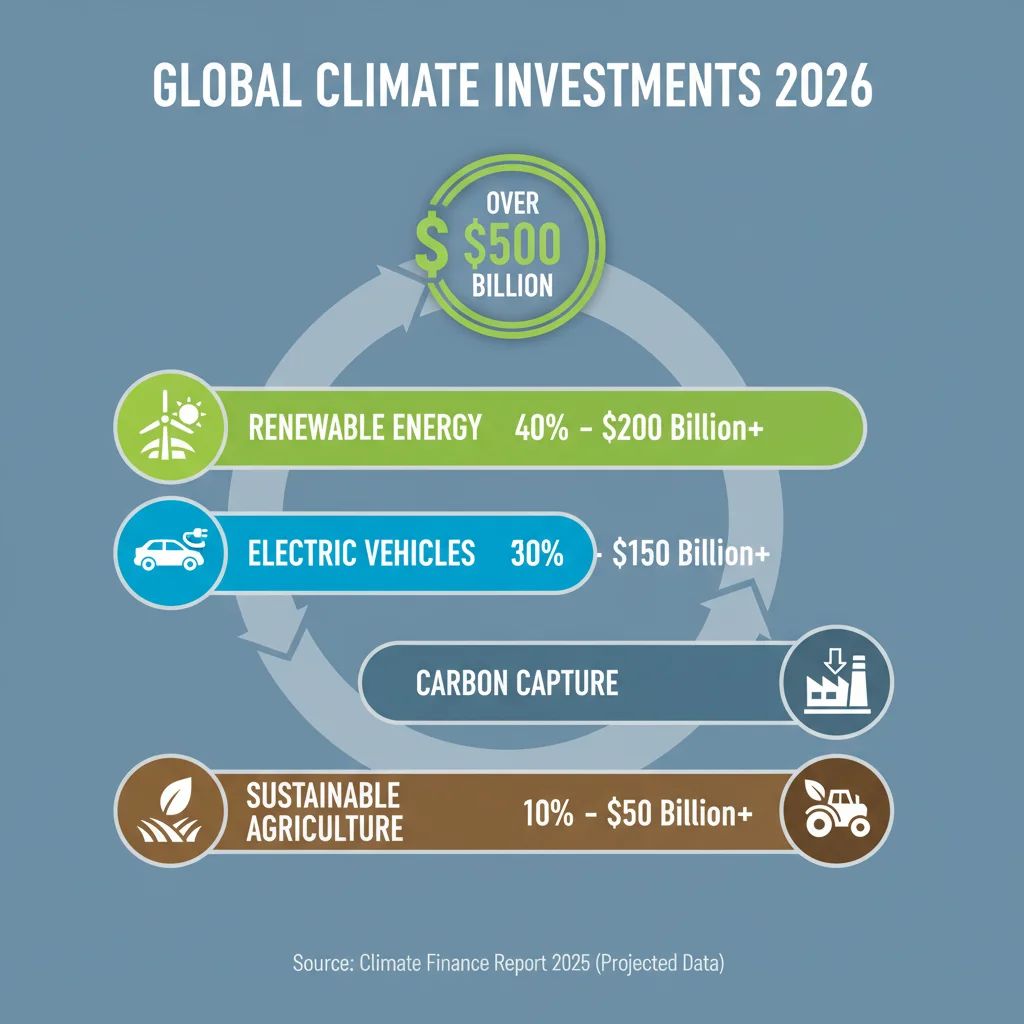
The projected $500 billion-plus investment in Climate Policies 2026 will not be evenly distributed but will instead flow into several critical sectors, transforming industries and creating new economic ecosystems. The renewable energy sector remains at the forefront, with significant capital directed towards solar, wind, hydropower, and geothermal projects. This includes not only the development of new generation capacity but also improvements in grid infrastructure, energy storage solutions, and smart grid technologies to manage intermittent renewable sources effectively.
Transportation is another major recipient, primarily driven by the rapid expansion of electric vehicles (EVs) and associated charging infrastructure. Investments will also target public transport electrification, hydrogen fuel cell technology for heavy-duty vehicles, and sustainable aviation fuels. The building sector is also poised for substantial investment in energy efficiency upgrades, green building materials, and smart home technologies, aiming to reduce energy consumption and carbon footprints of residential and commercial properties. Furthermore, sustainable agriculture and land use practices, including reforestation, carbon sequestration in soils, and precision farming, will see increased funding as part of broader climate resilience strategies. Finally, nascent but rapidly growing sectors like carbon capture, utilization, and storage (CCUS) and green hydrogen production are expected to attract significant research and development funding, paving the way for future large-scale deployment under Climate Policies 2026.
Economic Opportunities and Job Creation from Climate Policies 2026
The influx of over $500 billion in investments under Climate Policies 2026 is not just about mitigating environmental risks; it’s a powerful engine for economic growth and job creation. The development and deployment of renewable energy technologies, for instance, require a vast workforce, from engineers and technicians to construction workers and project managers. The manufacturing of solar panels, wind turbines, and electric vehicle components creates jobs in factories and supply chains globally. The installation and maintenance of these systems further bolster local economies.
Beyond direct employment, the green transition stimulates innovation across various industries. Companies are investing in research and development to create more efficient batteries, advanced materials, and smart energy management systems. This fosters a competitive environment that drives technological progress and creates high-value jobs. Moreover, the shift towards a circular economy, emphasizing recycling, reuse, and waste reduction, opens up entirely new business models and employment opportunities. For example, the refurbishment and repurposing of electronic waste, or the development of sustainable packaging solutions, represent burgeoning industries. The long-term economic benefits include increased energy independence, reduced volatility from fossil fuel price fluctuations, and improved public health due to cleaner air and water. These ripple effects extend far beyond the immediate investment figures, creating a more resilient and prosperous economy shaped by Climate Policies 2026.

Challenges and Risks in Implementing Climate Policies 2026
While the economic opportunities presented by Climate Policies 2026 are substantial, their successful implementation is not without challenges and risks. One significant hurdle is the initial capital expenditure required for large-scale green infrastructure projects. While the long-term returns are promising, the upfront costs can be substantial, requiring innovative financing mechanisms and strong government support. Policy uncertainty and inconsistency also pose a risk. Frequent changes in regulations or incentives can deter private investment and slow down project development. A stable and predictable policy environment is crucial for attracting the necessary capital.
Another challenge lies in workforce development. The transition to a green economy requires new skills and expertise. There’s a need for significant investment in education, training, and reskilling programs to ensure that the labor force is equipped for the jobs of the future. Supply chain disruptions, particularly for critical minerals and rare earth elements essential for renewable technologies and batteries, also present a risk. Diversifying supply chains and promoting domestic production where feasible will be vital. Furthermore, ensuring equitable distribution of the benefits and burdens of the green transition is paramount. Without careful planning, some communities or industries might be disproportionately affected, leading to social and economic disparities. Addressing these challenges effectively will be key to unlocking the full potential of Climate Policies 2026 and ensuring a just transition.
Global Cooperation and Regional Strategies for Climate Policies 2026
The scale of the climate challenge necessitates global cooperation, and the success of Climate Policies 2026 will largely depend on coordinated international efforts and tailored regional strategies. No single nation can tackle climate change alone, and the flow of over $500 billion in investments reflects a growing understanding of this interdependence. International forums like the UN Climate Change Conferences (COPs) continue to play a vital role in setting targets, facilitating knowledge sharing, and mobilizing financial resources, particularly for developing nations.
Regional strategies are equally important, as climate impacts and economic structures vary significantly across different parts of the world. For instance, European Union’s Green Deal aims for climate neutrality by 2050, with substantial investments in renewable energy, sustainable transport, and circular economy initiatives. In North America, policies like the Inflation Reduction Act in the United States are driving significant domestic investment in clean energy and manufacturing. Asian economies, particularly China and India, are making massive strides in renewable energy deployment and electric vehicle adoption, recognizing both the environmental imperative and the economic opportunities. Developing nations, often the most vulnerable to climate impacts, require financial and technological assistance to implement their own climate action plans. International development banks and climate funds are crucial in bridging this funding gap. The collective ambition and diverse approaches under Climate Policies 2026 highlight a complex but increasingly unified global effort.
Measuring Success and Impact of Climate Policies 2026
To ensure that the over $500 billion investment in Climate Policies 2026 yields tangible results, robust frameworks for measuring success and impact are essential. This goes beyond simply tracking financial outflows; it requires evaluating the actual environmental and economic outcomes. Key performance indicators (KPIs) will include reductions in greenhouse gas emissions, increases in renewable energy capacity, improvements in energy efficiency, and the creation of green jobs. Quantitative metrics are vital for accountability and for demonstrating the effectiveness of policies.
Beyond quantitative data, qualitative assessments are also important. This includes evaluating the social equity of climate policies, ensuring that benefits are broadly shared and that vulnerable communities are not left behind. Assessing the resilience of infrastructure to climate impacts and the extent of ecosystem restoration are also critical measures of success. Regular reporting, transparent data collection, and independent verification will build trust and inform future policy adjustments. The goal is not just to spend money but to achieve a genuine, measurable transition to a sustainable, low-carbon economy. This continuous evaluation cycle will be a cornerstone of effective Climate Policies 2026 and beyond.
The Role of Innovation and Technology in Climate Policies 2026
Innovation and technological advancement are indispensable pillars supporting the ambitious goals of Climate Policies 2026 and the associated $500 billion-plus investments. While current technologies provide many solutions, achieving net-zero emissions and building true climate resilience will necessitate breakthroughs in various fields. Research and development in areas like advanced energy storage (beyond lithium-ion batteries), small modular nuclear reactors, direct air capture, and next-generation biofuels are crucial. These emerging technologies have the potential to address hard-to-decarbonize sectors and provide solutions for intermittent renewable energy sources.
Digital technologies, such as artificial intelligence (AI), machine learning, and the Internet of Things (IoT), are also playing an increasingly significant role. AI can optimize energy grids, predict weather patterns for renewable energy generation, and improve the efficiency of industrial processes. IoT devices can monitor environmental conditions, track emissions, and enable smart urban planning. Furthermore, advancements in biotechnology and material science are paving the way for sustainable alternatives to traditional, carbon-intensive products, from biodegradable plastics to lab-grown foods. The continuous evolution of these technologies, fueled by significant investment, will be a game-changer in accelerating the transition under Climate Policies 2026, making ambitious climate targets more attainable and economically viable.
Future Outlook and Long-Term Impact of Climate Policies 2026
Looking beyond 2026, the long-term impact of current climate policies and investments is set to reshape the global economy for decades to come. The initial $500 billion-plus investment serves as a catalyst, expected to unlock further private sector capital as green markets mature and technologies become even more competitive. This fundamental shift will lead to a reorientation of capital markets, with sustainable investments becoming the norm rather than the exception. The global financial system is increasingly integrating climate risk and opportunity into its core operations, driving capital towards solutions that are both environmentally sound and economically robust.
The long-term benefits extend to enhanced energy security, as nations reduce their reliance on volatile fossil fuel markets by leveraging abundant domestic renewable resources. This transition also promises improved public health outcomes through reduced air and water pollution, leading to lower healthcare costs and increased productivity. Furthermore, the green economy is expected to be a significant source of innovation and global competitiveness. Countries and companies that lead in developing and deploying sustainable technologies will gain a strategic advantage in the global marketplace. The Climate Policies 2026 are not just a short-term response to an environmental crisis; they are laying the groundwork for a new era of sustainable prosperity, fostering a more resilient, equitable, and environmentally responsible global society.
Conclusion: A Green Revolution Fueled by Climate Policies 2026
The projected investment exceeding $500 billion in Climate Policies 2026 marks a pivotal moment in humanity’s response to climate change. It signifies a global recognition that environmental stewardship and economic prosperity are not mutually exclusive but deeply intertwined. This massive financial commitment is set to catalyze profound transformations across critical sectors, from renewable energy and sustainable transportation to green buildings and agriculture.
While challenges such as initial capital costs, policy consistency, and workforce development remain, the overwhelming economic opportunities and the imperative of climate action are driving this green revolution forward. The surge in investment is fostering innovation, creating millions of green jobs, and paving the way for a more resilient and sustainable global economy. The success of these Climate Policies 2026 will ultimately be measured not just in dollars spent, but in the tangible reductions of emissions, the health of our planet, and the improved well-being of its inhabitants. As we move forward, sustained commitment, collaborative action, and continuous innovation will be crucial to harnessing the full potential of these investments and building a truly sustainable future for generations to come.