
Navigating the Future: Understanding the 2026 Social Security COLA and Its Impact
As we move closer to 2026, millions of Americans who rely on Social Security benefits are keenly watching for updates regarding the Cost-of-Living Adjustment (COLA). The 2026 Social Security COLA is a critical topic, directly affecting the purchasing power and financial stability of retirees, disabled individuals, and survivors. Understanding how this adjustment is calculated, what factors influence it, and what current beneficiaries can expect is paramount for effective financial planning. While projections are inherently uncertain, early indicators and economic trends can provide valuable insights into potential adjustments, including the frequently discussed possibility of a 3% increase.
The Social Security Administration (SSA) implements COLA to ensure that the purchasing power of Social Security benefits is not eroded by inflation. Without these adjustments, the fixed income of beneficiaries would steadily lose value over time, making it harder to cover essential living expenses. This article will delve deep into the mechanics of the 2026 Social Security COLA, offering a comprehensive guide for current beneficiaries to prepare for the upcoming changes. We will explore the historical context of COLA, the current economic landscape, and expert predictions, providing you with the knowledge needed to navigate these important financial adjustments.
What is the Social Security COLA and Why is it Important?
The Cost-of-Living Adjustment (COLA) is an annual increase in Social Security and Supplemental Security Income (SSI) benefits to offset the effects of inflation. It’s designed to help beneficiaries maintain their standard of living as the cost of goods and services rises. Without COLA, a fixed Social Security payment would gradually buy less and less over time, placing a significant burden on individuals whose primary income source is their Social Security benefit.
The Genesis of COLA: Protecting Purchasing Power
COLA was first implemented in 1975, a direct response to periods of high inflation that significantly diminished the value of fixed incomes. Before this, benefit increases required an act of Congress. The automatic COLA provision ensures that benefits keep pace with the rising cost of living, providing a vital safety net for millions of Americans. This automatic adjustment mechanism is a cornerstone of the Social Security program, reflecting its commitment to supporting beneficiaries’ financial well-being.
How is the 2026 Social Security COLA Calculated?
The calculation of the 2026 Social Security COLA, like all previous COLAs, is tied to the Consumer Price Index for Urban Wage Earners and Clerical Workers (CPI-W). Specifically, the SSA compares the average CPI-W for the third quarter (July, August, and September) of the current year (2025 for the 2026 COLA) with the average CPI-W for the third quarter of the last year a COLA was payable. If there is an increase, the percentage difference rounded to the nearest tenth of a percent becomes the COLA for the following year. If there’s no increase or a decrease, there is no COLA for that year, though benefits do not decrease.
It’s crucial to understand that the CPI-W measures the average change over time in the prices paid by urban wage earners and clerical workers for a market basket of consumer goods and services. This includes everything from food and housing to transportation and medical care. Therefore, the trajectory of inflation, as captured by the CPI-W, is the single most important determinant of the 2026 Social Security COLA.
Factors Influencing the 2026 Social Security COLA
Several economic factors will play a pivotal role in determining the 2026 Social Security COLA. Understanding these elements can help beneficiaries anticipate potential adjustments and plan accordingly.
Inflation Trends: The Primary Driver
As established, inflation is the core determinant of COLA. For the 2026 Social Security COLA, the inflation trends leading up to and during the third quarter of 2025 will be paramount. Persistent high inflation typically leads to higher COLA percentages, while disinflationary periods or even deflation could result in lower or no COLA. Economists constantly monitor various inflation indicators, such as the Consumer Price Index (CPI), producer prices, and wage growth, to forecast future COLA figures.
Factors contributing to inflation include global supply chain issues, energy prices, geopolitical events, and consumer demand. A robust economy with strong consumer spending can push prices higher, potentially leading to a more substantial 2026 Social Security COLA. Conversely, an economic slowdown could dampen inflationary pressures.
Economic Growth and Wage Increases
While not directly used in the COLA calculation, overall economic growth and wage increases can indirectly influence inflation. Strong wage growth can lead to increased consumer spending, which in turn can drive up prices. A healthy economy generally means more stable and predictable inflation, which can be beneficial for COLA predictions. However, runaway wage growth without corresponding productivity gains can lead to a wage-price spiral, further fueling inflation.
Federal Reserve Policies
The Federal Reserve’s monetary policy decisions, particularly interest rate adjustments, have a significant impact on inflation. By raising interest rates, the Fed aims to cool down an overheating economy and curb inflation. Conversely, lowering rates can stimulate economic activity but might also reignite inflationary pressures. The Fed’s actions throughout 2024 and 2025 will be crucial in shaping the economic environment that ultimately determines the 2026 Social Security COLA.
Global Events and Supply Chains
Recent years have highlighted the profound impact of global events on inflation. Wars, natural disasters, and pandemics can disrupt supply chains, leading to shortages and increased prices for various goods. These external shocks are unpredictable but can significantly sway inflation numbers, making the 2026 Social Security COLA harder to forecast accurately far in advance.
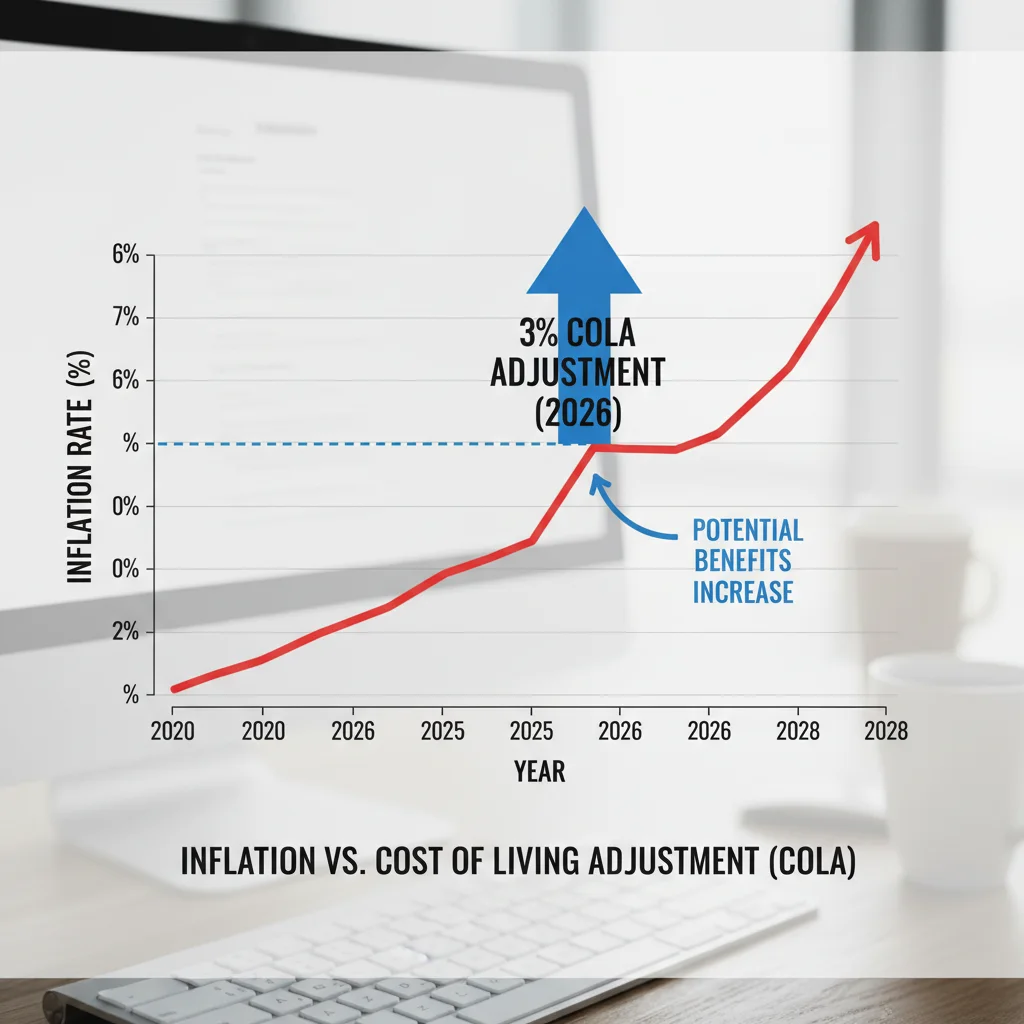
Projections for the 2026 Social Security COLA: The 3% Possibility
Speculation about the 2026 Social Security COLA often centers around specific percentage increases. A 3% COLA adjustment is a figure that frequently surfaces in discussions, reflecting a balance between current economic trends and historical averages. While it’s too early for definitive figures, preliminary analysis based on current inflation projections suggests that a moderate COLA, potentially around 3%, could be a reasonable expectation.
Understanding the 3% Projection
A 3% COLA would mean that Social Security beneficiaries would see their monthly payments increase by 3% starting in January 2026. For someone receiving a $1,800 monthly benefit, a 3% COLA would translate to an additional $54 per month, bringing their new benefit to $1,854. While this might seem like a modest increase, it can significantly impact the budgets of those on fixed incomes.
This projection is often based on current forecasts for the CPI-W, which anticipate continued, albeit potentially moderating, inflationary pressures. However, these are early estimates and can change dramatically based on economic developments over the next year and a half. Beneficiaries should view these projections as guides rather than guarantees.
Historical COLA Trends
Looking at historical COLA trends can provide context. In recent years, COLAs have varied significantly, reflecting the volatile economic landscape. There have been periods of very low or even no COLA during times of low inflation, and years with substantial increases during periods of high inflation. For example, beneficiaries saw a significant increase in 2022 and 2023 due to elevated inflation. A 3% 2026 Social Security COLA would be in line with some of these more recent adjustments, indicating a continued effort to keep pace with living costs.
The Role of CPI-E vs. CPI-W
An ongoing debate concerns whether the COLA should be based on the Consumer Price Index for the Elderly (CPI-E) instead of the CPI-W. Advocates for CPI-E argue that it better reflects the spending patterns of seniors, who typically spend more on healthcare and housing, categories that often experience higher inflation rates than the general basket of goods and services measured by the CPI-W. If the 2026 Social Security COLA were calculated using CPI-E, the adjustment could potentially be higher, offering more robust protection against inflation for elderly beneficiaries. However, as of now, the CPI-W remains the official metric.
What Current Beneficiaries Need to Know for 2026
For current Social Security beneficiaries, preparing for the 2026 Social Security COLA involves understanding how it will affect their finances, potential changes to Medicare premiums, and other related benefits.
Impact on Monthly Benefits
The most direct impact of the 2026 Social Security COLA will be on the monthly benefit amount. An increase, even a moderate one like 3%, will mean more money in beneficiaries’ pockets. This additional income can help cover rising costs of groceries, utilities, and other essential expenses. It’s important for beneficiaries to monitor their Social Security statements and official announcements from the SSA to confirm their new benefit amount for 2026.
Medicare Premium Adjustments
A significant consideration for many beneficiaries is the interaction between COLA and Medicare Part B premiums. By law, most Social Security beneficiaries are protected by the ‘hold harmless’ provision, meaning their Medicare Part B premium increase cannot cause their net Social Security benefit to decrease. However, this provision primarily applies to individuals whose Part B premiums are deducted directly from their Social Security checks.
For those not covered by ‘hold harmless’ (e.g., high-income earners, new enrollees, or those who pay directly), an increase in Medicare Part B premiums could potentially offset some or all of the 2026 Social Security COLA. It’s crucial for beneficiaries to stay informed about Medicare premium announcements, which typically occur in the fall, shortly after the COLA is announced.
Taxation of Social Security Benefits
Another area of impact is the taxation of Social Security benefits. Depending on a beneficiary’s combined income (adjusted gross income + non-taxable interest + half of Social Security benefits), a portion of their Social Security benefits may be taxable. A higher 2026 Social Security COLA means a higher gross benefit, which could, for some individuals, push their combined income over the thresholds that trigger taxation. Beneficiaries should consult with a tax professional to understand how a COLA increase might affect their tax liability.
Planning for the Future: Budgeting and Financial Adjustments
Regardless of the final 2026 Social Security COLA, beneficiaries should continuously review and adjust their budgets. Understanding their income and expenses is vital for financial security. If the COLA is lower than expected, it might necessitate tightening budgets or exploring additional income streams. If it’s higher, it could provide a welcome cushion or an opportunity to save more.
It’s also a good practice to factor in potential healthcare cost increases, which often outpace general inflation. Having an emergency fund and reviewing insurance coverage can provide peace of mind in an uncertain economic environment. The 2026 Social Security COLA is just one piece of the broader financial puzzle for retirees and other beneficiaries.

The Broader Economic Picture and Social Security’s Future
The 2026 Social Security COLA does not exist in a vacuum; it’s part of a larger economic and demographic landscape that impacts the long-term solvency of the Social Security program. While COLA helps beneficiaries, the overall health of the Social Security trust funds remains a critical concern.
Demographic Shifts and Trust Fund Solvency
The Social Security program faces long-term financial challenges primarily due to demographic shifts, including lower birth rates and increased life expectancy. Fewer workers are contributing per retiree, putting pressure on the system. While COLA ensures benefits keep pace with inflation, it also increases outlays from the trust funds. Discussions around Social Security reform often touch upon these long-term solvency issues, independent of annual COLA adjustments.
Political and Policy Debates
The future of Social Security is frequently a topic of political debate. Proposals for reform range from adjusting the full retirement age to changing the COLA calculation method (e.g., to CPI-E), or modifying the taxation of benefits. While these broader policy discussions are separate from the annual 2026 Social Security COLA calculation, they underscore the importance of staying informed about the program’s overall trajectory.
Staying Informed: Official Sources
For the most accurate and up-to-date information regarding the 2026 Social Security COLA, beneficiaries should rely on official sources. The Social Security Administration (SSA) is the primary authority. Their website (ssa.gov) provides detailed information, press releases, and benefit calculators. News outlets and financial advisors often report on COLA predictions, but the SSA’s official announcement in October (for the following year’s COLA) is the definitive source.
Preparing for the 2026 Social Security COLA: A Checklist
To help current beneficiaries prepare for the upcoming 2026 Social Security COLA, here’s a practical checklist:
- Monitor Inflation Reports: Keep an eye on inflation data, particularly the CPI-W, as reported by the Bureau of Labor Statistics. This will give you an early indication of potential COLA trends.
- Review Your Current Budget: Understand your monthly income and expenses. Identify areas where you can adjust spending if needed, regardless of the COLA.
- Anticipate Medicare Premium Changes: Be aware that Medicare Part B premiums may also adjust annually. Factor these potential changes into your financial planning.
- Check Your Social Security Account: Regularly log in to your My Social Security account on the SSA website. This is where you can view your benefit statements and receive official notifications.
- Consult a Financial Advisor: If you have complex financial situations or questions about how COLA might affect your retirement strategy, seek advice from a qualified financial planner.
- Stay Updated with Official SSA Announcements: The official COLA announcement typically happens in October. Make sure to check the SSA website or reliable news sources for this critical update.
- Understand Tax Implications: If your income is close to the thresholds for Social Security benefit taxation, consult a tax professional to understand how a COLA increase might affect your tax liability.
By proactively engaging with these steps, beneficiaries can ensure they are well-prepared for the 2026 Social Security COLA and its broader financial implications.
Conclusion: Staying Ahead of the 2026 Social Security COLA
The 2026 Social Security COLA is an essential adjustment designed to protect the financial well-being of millions of Americans. While a definitive percentage won’t be announced until late 2025, understanding the calculation methodology, the influencing economic factors, and potential projections like a 3% increase can empower current beneficiaries to plan effectively. Inflation trends, Federal Reserve policies, and global events will all play a part in shaping the final COLA figure.
For current beneficiaries, the key is to stay informed through official channels, review personal financial situations, and anticipate how these changes might interact with other benefits like Medicare. By taking proactive steps and understanding the nuances of the 2026 Social Security COLA, individuals can better secure their financial future and maintain their purchasing power in an ever-evolving economic landscape. The ongoing commitment to providing these adjustments underscores the vital role Social Security plays in the lives of American seniors and other eligible individuals, ensuring they can continue to meet their basic needs and live with dignity.