Student Loan Repayment 2026: Navigating the SAVE Plan

Student loan debt continues to be a significant financial burden for millions of Americans. As we approach 2026, understanding the evolving landscape of repayment options is more critical than ever. Among the various plans designed to ease this burden, the SAVE Plan 2026 stands out as a pivotal development. This comprehensive guide will delve deep into the SAVE Plan, providing you with the knowledge and strategies necessary to navigate your student loan repayment effectively, ensuring you are well-prepared for the financial year ahead.
The federal student loan system has undergone numerous changes, with the goal of making repayment more manageable and accessible. The SAVE Plan, or Saving on a Valuable Education Plan, is the latest iteration of income-driven repayment (IDR) plans, designed to offer significant relief to borrowers. Its introduction marks a substantial shift in how student loans are repaid, potentially lowering monthly payments for millions and offering a clearer path to loan forgiveness. For anyone with federal student loans, grasping the intricacies of the SAVE Plan 2026 is not just beneficial; it’s essential for financial stability.
Many borrowers are grappling with questions about how these changes will impact their personal finances. Will their monthly payments decrease? Are they eligible for loan forgiveness sooner? What steps do they need to take to enroll or ensure they remain enrolled? This article aims to answer these questions and more, providing a detailed roadmap for understanding and utilizing the SAVE Plan 2026 to your advantage. We will explore its core features, eligibility requirements, the benefits it offers, and how it compares to previous IDR plans. Furthermore, we will offer practical advice on how to integrate the SAVE Plan into your broader financial planning, ensuring you can manage your student debt without compromising your other financial goals.
Understanding the Basics of the SAVE Plan 2026
The SAVE Plan 2026 is an enhanced income-driven repayment plan that replaces the Revised Pay As You Earn (REPAYE) Plan. Its primary objective is to make student loan payments more affordable by calculating them based on a borrower’s discretionary income and family size, rather than their loan balance. This approach ensures that payments are more closely aligned with a borrower’s ability to pay, providing a crucial safety net for those with lower incomes or high debt-to-income ratios.
One of the most significant changes introduced by the SAVE Plan is the adjustment to how discretionary income is calculated. Under previous IDR plans, discretionary income was defined as the amount of a borrower’s adjusted gross income (AGI) that exceeded 150% of the federal poverty guideline for their family size. The SAVE Plan increases this threshold to 225% of the federal poverty guideline. This means a larger portion of a borrower’s income is protected, leading to lower or even $0 monthly payments for many.
For example, consider a single borrower with an AGI of $35,000. Under the old REPAYE plan, their discretionary income would be calculated based on 150% of the poverty line. With the SAVE Plan 2026, that threshold increases to 225%, effectively reducing their calculated discretionary income, and consequently, their monthly payment. This change alone is projected to save millions of borrowers hundreds of dollars each month.
Another key feature of the SAVE Plan is its interest subsidy. Many borrowers on IDR plans find that their monthly payments aren’t enough to cover the accruing interest, leading to a ballooning loan balance. The SAVE Plan addresses this by covering any unpaid interest after a borrower makes their required monthly payment. This means that if your calculated payment is less than the interest that accrues each month, the government will cover the difference, preventing your loan balance from growing due to unpaid interest. This is a game-changer for many, offering a genuine path to reducing total debt rather than just managing it.
The SAVE Plan also offers a faster path to loan forgiveness for certain borrowers. While the standard forgiveness period for IDR plans is typically 20 or 25 years, the SAVE Plan introduces a shorter forgiveness timeline for those with lower original loan balances. Forgiveness will be granted after 10 years of payments for borrowers whose original principal loan balance was $12,000 or less. For every additional $1,000 borrowed above $12,000, an additional year of payments is added, up to a maximum of 20 or 25 years, depending on whether the loans are for undergraduate or graduate study. This incentivizes borrowers with smaller debts to stay on track and provides earlier relief.
It’s important to note that the SAVE Plan 2026 applies to most federal student loans, including Direct Subsidized Loans, Direct Unsubsidized Loans, Direct PLUS Loans made to students, and Direct Consolidation Loans that did not include Parent PLUS Loans. Federal Family Education Loan (FFEL) Program loans and Perkins Loans are generally not eligible unless they are consolidated into a Direct Consolidation Loan. Understanding which of your loans qualify is the first step in determining your potential benefits under the SAVE Plan.
Eligibility Requirements for the SAVE Plan
To enroll in the SAVE Plan 2026, borrowers must meet specific eligibility criteria. The most fundamental requirement is that you must have eligible federal student loans. As mentioned, most Direct Loans qualify, but it’s crucial to confirm the type of loans you hold. If you have FFEL or Perkins Loans, you might need to consolidate them into a Direct Consolidation Loan to become eligible. This consolidation process can take several weeks, so it’s advisable to start early if you plan to go this route.
Another key factor is your income and family size. The SAVE Plan calculates your monthly payment based on your discretionary income, which is your AGI minus 225% of the federal poverty guideline for your family size. This means that as your income decreases or your family size increases, your calculated discretionary income will be lower, potentially leading to a lower monthly payment. Conversely, if your income increases significantly, your payments may also increase.
You will need to provide documentation of your income to enroll and annually thereafter. This typically includes your most recent federal income tax return or alternative documentation of income, such as pay stubs or a letter from your employer. It is crucial to recertify your income and family size each year to ensure your payments remain accurate and to avoid capitalization of interest or removal from the plan. Missing your annual recertification deadline can lead to higher payments and the loss of the interest subsidy, so setting reminders is highly recommended.
While the SAVE Plan offers substantial benefits, it’s not a one-size-fits-all solution. Borrowers should carefully consider their individual financial situation, including their current income, future income projections, loan balance, and career goals, before deciding if the SAVE Plan 2026 is the best option for them. For some, particularly those with higher incomes and lower debt, other repayment plans like the Standard Repayment Plan or Graduated Repayment Plan might be more suitable for paying off their loans faster and minimizing total interest paid.

Benefits and Advantages of the SAVE Plan 2026
The SAVE Plan 2026 offers several compelling benefits that make it an attractive option for many federal student loan borrowers:
- Lower Monthly Payments: By increasing the discretionary income threshold to 225% of the federal poverty line, many borrowers will see significantly reduced monthly payments, with some even qualifying for a $0 payment. This can free up crucial funds for other living expenses or savings goals.
- Interest Subsidy: One of the most impactful features is the 100% interest subsidy. If your monthly payment doesn’t cover all the accrued interest, the government pays the difference. This prevents your loan balance from growing, a common problem with other IDR plans, and allows borrowers to make real progress on their principal.
- Faster Path to Forgiveness for Smaller Balances: For borrowers with original principal balances of $12,000 or less, loan forgiveness can be achieved after just 10 years of payments. This is a significant improvement over the standard 20 or 25-year timelines and provides much-needed relief to those with smaller, but still burdensome, debts.
- Protection Against Wage Garnishment and Default: By offering affordable payments, the SAVE Plan helps borrowers avoid delinquency and default, protecting their credit scores and preventing severe consequences such as wage garnishment or tax refund offset.
- No Spousal Income Inclusion for Married Filing Separately: For married borrowers who file their taxes separately, the SAVE Plan does not include spousal income in the payment calculation. This can be a substantial advantage for individuals with high-earning spouses but who wish to keep their student loan payments based solely on their own income.
- Automatic Enrollment for Certain Borrowers: While not universal, some borrowers previously on the REPAYE plan may be automatically transitioned to the SAVE Plan, simplifying the process for them. However, it’s always wise to confirm your enrollment status.
These benefits collectively aim to create a more equitable and sustainable student loan repayment system. The emphasis on preventing interest capitalization and offering quicker forgiveness for smaller balances demonstrates a clear commitment to alleviating the long-term financial strain associated with student debt. For many, the SAVE Plan 2026 represents a crucial step towards financial freedom.
Comparing SAVE with Other Income-Driven Repayment Plans
Before the SAVE Plan 2026, borrowers had several IDR options, including Income-Based Repayment (IBR), Pay As You Earn (PAYE), and Revised Pay As You Earn (REPAYE). While all these plans aim to make payments affordable based on income, the SAVE Plan introduces key enhancements that set it apart.
Discretionary Income Calculation: The most significant difference lies in the calculation of discretionary income. As discussed, the SAVE Plan protects 225% of the federal poverty guideline, compared to 150% for most other IDR plans. This change alone will result in lower payments for virtually all borrowers who qualify for an IDR plan.
Interest Subsidy: While REPAYE offered a partial interest subsidy (50% of unpaid interest on subsidized loans for the first three years, and 50% of unpaid interest on unsubsidized loans for the entire period), the SAVE Plan provides a 100% interest subsidy. This means that as long as you make your required monthly payment, your loan balance will not grow due to accruing interest. This is a major improvement over all previous IDR plans.
Forgiveness Timelines: While the maximum repayment period for forgiveness under most IDR plans is 20 or 25 years, the SAVE Plan introduces the accelerated forgiveness for smaller loan balances (10 years for original balances of $12,000 or less). This targeted relief for lower-balance borrowers is unique to the SAVE Plan.
Spousal Income: Under the REPAYE Plan, spousal income was always included in the payment calculation, regardless of how taxes were filed. The SAVE Plan 2026 allows married borrowers who file separately to exclude their spouse’s income from the payment calculation, offering more flexibility and potentially lower payments for individuals in such situations.
Payment Caps: Unlike the IBR and PAYE plans, which cap monthly payments at the amount you would pay under the Standard Repayment Plan, the SAVE Plan has no payment cap. While this means payments could theoretically increase significantly if your income rises substantially, the interest subsidy and the overall lower discretionary income calculation often mitigate this concern for most borrowers. However, it’s a point to consider for those expecting substantial income growth.
For most federal student loan borrowers, especially those struggling with high debt relative to their income, the SAVE Plan 2026 will likely be the most beneficial repayment option. Its enhanced features are designed to provide greater financial relief and a more predictable path to debt freedom.
How to Enroll in the SAVE Plan 2026
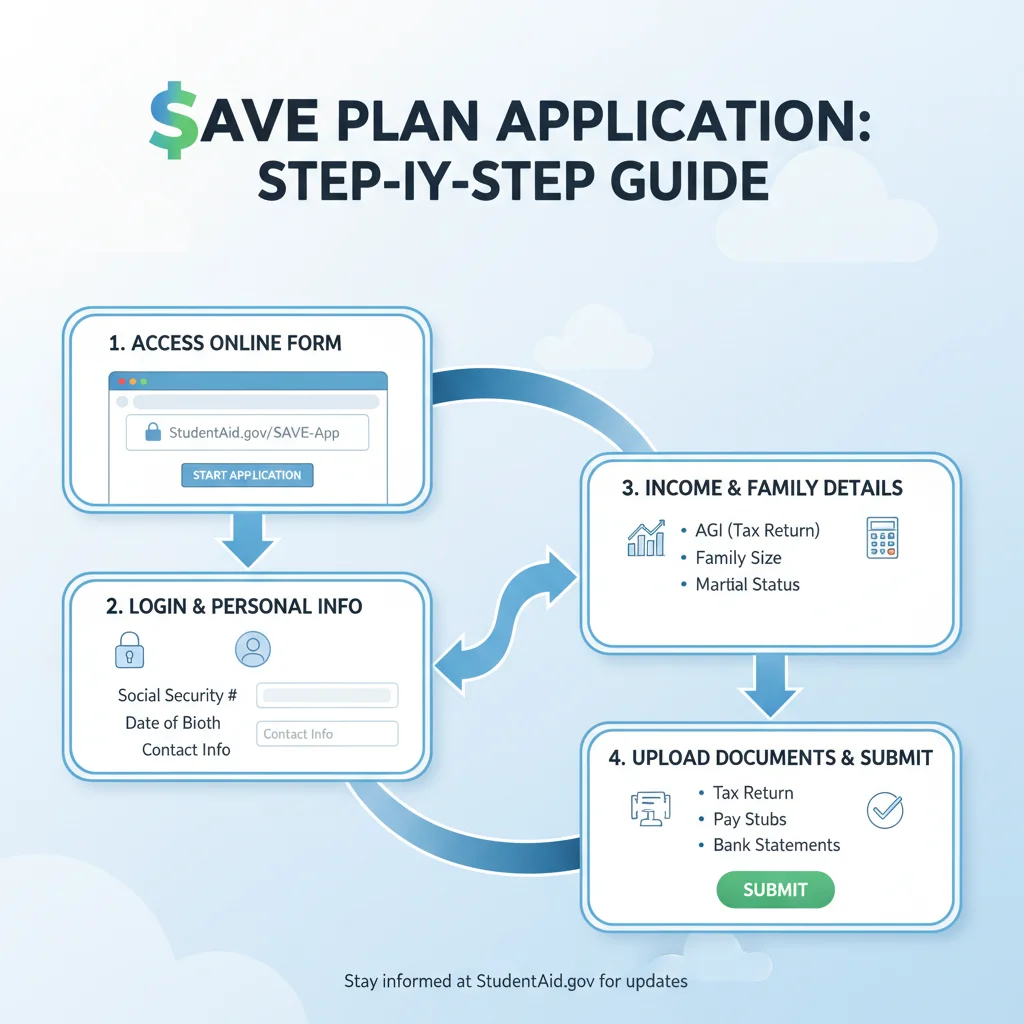
Enrolling in the SAVE Plan 2026 is a straightforward process, primarily managed through the Federal Student Aid (FSA) website. Here’s a step-by-step guide:
- Gather Your Information: You’ll need your FSA ID, financial information (AGI from your most recent tax return or alternative income documentation), and details about your family size.
- Visit StudentAid.gov: Navigate to the FSA website and log in with your FSA ID.
- Apply for an Income-Driven Repayment Plan: Look for the section related to income-driven repayment plans. You’ll typically find an option to ‘Apply for an Income-Driven Repayment Plan’ or ‘Recalculate My Monthly Payment.’
- Select the SAVE Plan: During the application process, you will be presented with various IDR options. Select the SAVE Plan (or it might be listed as ‘Saving on a Valuable Education Plan’).
- Provide Income and Family Size Information: You can often link your application directly to the IRS to automatically retrieve your tax information. If you haven’t filed recently or your income has changed significantly, you may need to manually provide alternative documentation.
- Review and Submit: Carefully review all the information you’ve entered to ensure accuracy. Once satisfied, submit your application.
- Monitor Your Application Status: After submission, you can usually track the status of your application through your FSA account. Your loan servicer will also notify you once your application has been processed and your new payment amount is determined.
It’s crucial to apply well before your current repayment plan expires or if you are transitioning out of a grace period or deferment. Delays can result in higher payments or interest capitalization. If you are already on the REPAYE Plan, you may be automatically transitioned, but it’s always best to confirm with your loan servicer.
Impact on Your Monthly Budget and Financial Planning
The SAVE Plan 2026 has the potential to significantly impact your monthly budget, primarily by reducing your student loan payments. This reduction can free up funds that can be allocated to other financial priorities, such as:
- Building an Emergency Fund: A robust emergency fund is vital for financial security. Lower student loan payments can help you build this fund more quickly, providing a buffer against unexpected expenses.
- Paying Down High-Interest Debt: If you have credit card debt or other high-interest loans, redirecting the savings from your student loan payments towards these debts can accelerate your debt repayment and save you a substantial amount in interest over time.
- Investing for the Future: With more disposable income, you can increase your contributions to retirement accounts (401(k), IRA) or other investment vehicles, helping you achieve your long-term financial goals sooner.
- Saving for a Down Payment: Whether it’s for a house, a car, or another large purchase, reduced loan payments can make it easier to save for these significant life events.
- General Budget Relief: For many, the simple act of having lower fixed expenses can reduce financial stress and improve overall quality of life, allowing for more flexibility in daily spending.
When incorporating the SAVE Plan into your financial planning, it’s essential to consider the implications of potential loan forgiveness. While forgiveness is a significant benefit, the forgiven amount may be considered taxable income by the IRS at the time of forgiveness, unless Congress extends the current tax-exempt status of student loan forgiveness. It’s wise to consult with a tax professional to understand the potential tax implications and plan accordingly, perhaps by setting aside funds for a future tax bill.
Regularly reviewing your budget and financial goals is crucial. As your income or family size changes, your SAVE Plan payments will also adjust. Staying on top of your annual recertification and proactively updating your loan servicer with any significant life changes will ensure your payments remain accurate and you continue to reap the benefits of the plan.
Common Misconceptions and FAQs about the SAVE Plan
Despite its benefits, several misconceptions surround the SAVE Plan 2026. Addressing these can help borrowers make informed decisions:
Misconception 1: The SAVE Plan is only for low-income borrowers.
While the SAVE Plan certainly benefits low-income borrowers with $0 payments, its expanded discretionary income threshold and interest subsidy can provide significant relief to a wide range of income levels. Many middle-income borrowers will also see reduced payments and prevent their balances from growing.
Misconception 2: All my student loans are eligible for the SAVE Plan.
Only federal student loans, primarily Direct Loans, are eligible. Private student loans are not. FFEL and Perkins Loans may become eligible only after consolidation into a Direct Consolidation Loan.
Misconception 3: My loan balance will automatically decrease.
The SAVE Plan prevents your balance from growing due to unpaid interest, but it doesn’t automatically reduce your principal balance unless your payments exceed the interest. Principal reduction primarily occurs through consistent payments or through loan forgiveness after the required repayment period.
Misconception 4: Loan forgiveness under SAVE is tax-free.
Currently, loan forgiveness under IDR plans is tax-free until December 31, 2025, due to the American Rescue Plan Act. However, unless this provision is extended, forgiven amounts may be subject to federal income tax (and potentially state income tax) after this date. It’s essential to plan for this potential tax liability.
Misconception 5: I only need to apply once.
Borrowers must recertify their income and family size annually to remain on the SAVE Plan. Failing to do so can lead to your payments reverting to a higher amount and the capitalization of unpaid interest.
Frequently Asked Questions:
- Can I switch to the SAVE Plan from another IDR plan? Yes, you can generally switch to the SAVE Plan from any other IDR plan.
- What happens if my income changes significantly? You can request an income recertification at any time if your income decreases or your family size increases, which may lower your payments.
- Does the SAVE Plan count towards Public Service Loan Forgiveness (PSLF)? Yes, payments made under the SAVE Plan count towards the 120 qualifying payments required for PSLF, provided you meet all other PSLF eligibility criteria.
- What if I’m currently in default? Borrowers in default may need to rehabilitate or consolidate their loans to become eligible for the SAVE Plan.
Future Outlook and What to Expect in 2026 and Beyond
As we move into 2026, the SAVE Plan is expected to fully mature, with all its provisions taking full effect. This includes the full implementation of the reduced payment calculation for undergraduate loans (which will drop from 10% to 5% of discretionary income above 225% of the poverty line). This phased implementation means that even borrowers already on the SAVE Plan will likely see further reductions in their monthly payments for undergraduate loans in July 2024, and the full impact will be felt in 2026.
The Department of Education will continue to provide updates and resources, and it’s crucial for borrowers to stay informed through official channels like StudentAid.gov. Policy changes, economic shifts, and legislative actions could all influence the future of student loan repayment, so remaining proactive in monitoring your loan status and available options is key.
The long-term goal of the SAVE Plan is to create a more sustainable and equitable student loan system, reducing the burden on borrowers and fostering economic mobility. While no plan is perfect, the SAVE Plan represents a significant step forward in addressing the challenges of student loan debt in the United States. Its success will be measured not only by the immediate relief it provides but also by its ability to prevent future generations from accumulating insurmountable debt.
Borrowers should also be aware of potential scams. Always verify information directly with your loan servicer or StudentAid.gov. Never pay for services that promise to enroll you in the SAVE Plan or offer loan forgiveness, as these are often scams. All federal student loan services and information are available for free.
Conclusion: Empowering Your Financial Future with the SAVE Plan 2026
The student loan landscape is complex, but understanding programs like the SAVE Plan 2026 empowers you to take control of your financial future. By offering lower monthly payments, preventing interest capitalization, and providing a clearer path to forgiveness, the SAVE Plan is a powerful tool for managing federal student loan debt.
As you prepare for 2026, take the time to assess your eligibility, understand the benefits, and compare it with other repayment options. Utilize the resources available on StudentAid.gov and don’t hesitate to contact your loan servicer for personalized guidance. Proactive engagement with your student loan repayment strategy can lead to significant financial relief and lay a stronger foundation for your overall economic well-being.
Remember, managing student debt is a marathon, not a sprint. The SAVE Plan 2026 is designed to make that marathon more manageable, allowing you to focus on your career, family, and other life goals without the crushing weight of unmanageable debt. Stay informed, stay proactive, and leverage the SAVE Plan to your advantage.