EITC Eligibility 2026: Claim Your $7,430 Tax Credit – Insider Guide

EITC Eligibility 2026: Your Definitive Guide to Claiming Up to $7,430
Are you a working individual or family looking to maximize your tax refund in 2026? The Earned Income Tax Credit (EITC) is one of the most powerful and beneficial tax credits available, designed to put money back into the pockets of low-to-moderate income workers. For the 2026 tax year, eligible families could see a credit of up to $7,430! However, navigating the rules and ensuring you meet all the requirements for EITC Eligibility 2026 can be complex. This comprehensive guide is here to demystify the process, providing you with insider knowledge to confidently claim the credit you deserve.
The EITC is not just a deduction; it’s a refundable tax credit, meaning it can result in a refund even if you don’t owe any tax. This makes it a critical financial lifeline for millions of working Americans. But with annual adjustments to income thresholds, qualifying child rules, and other criteria, staying informed is crucial. We’ll delve into the specifics of what the EITC is, who qualifies, how to calculate your potential credit, and common pitfalls to avoid. By the end of this article, you’ll have a clear roadmap to understanding your EITC Eligibility 2026 and ensuring you don’t leave any money on the table.
Understanding the Earned Income Tax Credit (EITC)
The Earned Income Tax Credit (EITC) is a federal tax credit for low- to moderate-income working individuals and couples, particularly those with children. Its primary goal is to offset the burden of Social Security taxes and provide an incentive to work. Since its inception in 1975, the EITC has lifted millions of people out of poverty and continues to be one of the most effective anti-poverty programs in the United States.
Unlike a tax deduction, which reduces your taxable income, a tax credit directly reduces the amount of tax you owe. The EITC is special because it’s a refundable credit. This means that if the credit amount is more than the tax you owe, you can receive the difference as a refund. For example, if you owe $500 in taxes but qualify for a $2,000 EITC, you would receive a $1,500 refund. This can be a significant boost to a household’s annual income.
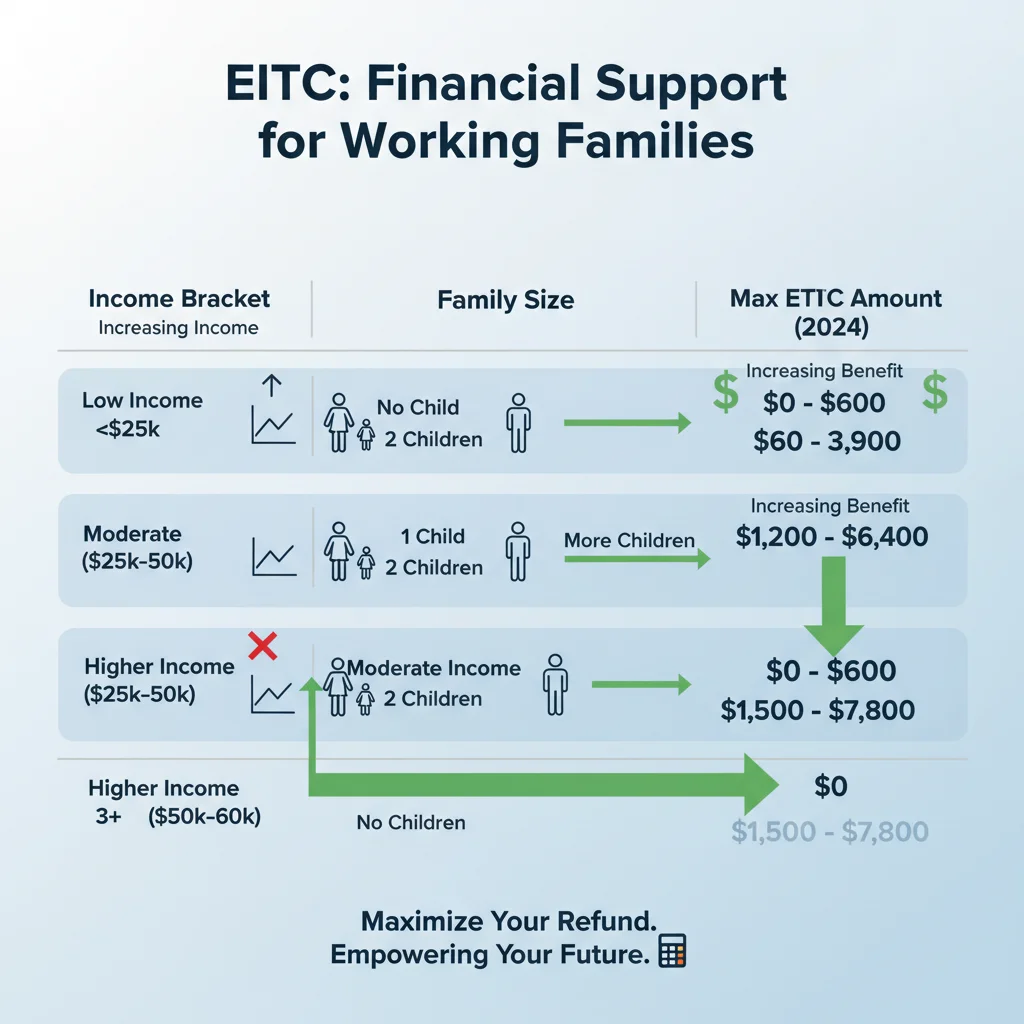
The amount of EITC you can receive depends on several factors, including your income, your filing status, and the number of qualifying children you have. The maximum credit is adjusted annually for inflation. For the 2026 tax year, the maximum credit is projected to be around $7,430 for those with three or more qualifying children. However, this amount can change based on final IRS guidance, so always refer to the latest official publications.
Why is EITC So Important for Working Families?
For many working families, the EITC represents a crucial financial safety net. It helps cover essential expenses, allowing families to invest in their children’s future, pay down debt, or save for emergencies. Beyond its immediate financial impact, studies have shown that the EITC has long-term benefits, including improved maternal and infant health, better academic outcomes for children, and increased economic mobility.
Understanding and claiming the EITC is not just about getting a refund; it’s about accessing a vital resource designed to support economic stability and growth for those who need it most. Many eligible individuals and families still miss out on this credit, often due to a lack of awareness or confusion about the eligibility rules. Our goal is to ensure you are fully equipped with the knowledge to claim your rightful credit for EITC Eligibility 2026.
EITC Eligibility 2026: Key Criteria You Must Meet
Determining your EITC Eligibility 2026 involves meeting several specific requirements set by the IRS. It’s crucial to review each criterion carefully, as missing even one could disqualify you. These requirements generally fall into categories related to earned income, adjusted gross income (AGI), filing status, residency, and qualifying children.
1. Earned Income and Adjusted Gross Income (AGI) Limits
To qualify for the EITC, you must have earned income. Earned income includes wages, salaries, tips, and other taxable employee pay, as well as net earnings from self-employment. Unemployment benefits, Social Security benefits, and pensions generally do not count as earned income for EITC purposes.
Both your earned income and your Adjusted Gross Income (AGI) must be below certain thresholds, which vary based on your filing status and the number of qualifying children you claim. These thresholds are adjusted annually for inflation. While the official 2026 figures won’t be released until late 2025, we can project based on historical adjustments. For illustration, here are the approximate projected income limits for 2026 (these are estimates and subject to change by the IRS):
- No Qualifying Children: Around $18,000 – $19,000
- One Qualifying Child: Around $49,000 – $50,000
- Two Qualifying Children: Around $55,000 – $56,000
- Three or More Qualifying Children: Around $59,000 – $60,000
It’s important to note that if your investment income (interest, dividends, capital gains, etc.) exceeds a certain amount (typically around $11,000 for 2026), you may not qualify for the EITC, regardless of your earned income. Always check the official IRS publications for the definitive 2026 limits once they are released.
2. Filing Status Requirements
Your filing status also plays a critical role in EITC Eligibility 2026. You generally cannot claim the EITC if your filing status is Married Filing Separately. The most common eligible filing statuses are:
- Single
- Married Filing Jointly
- Head of Household
- Qualifying Widow(er) with Dependent Child
If you are married, you generally must file a joint return to claim the EITC, even if only one spouse has earned income. There are very limited exceptions to this rule for victims of domestic abuse or spousal abandonment.
3. Age Requirements
For taxpayers without a qualifying child, there are specific age requirements:
- You must be at least 25 years old but under 65 years old at the end of the tax year.
- If filing a joint return, at least one spouse must meet this age requirement.
These age restrictions do not apply if you have a qualifying child.
4. Residency and Citizenship
You must be a U.S. citizen or a resident alien all year. If you were a nonresident alien for any part of the tax year, you generally cannot claim the EITC unless you are married to a U.S. citizen or resident alien and elect to treat yourself as a resident alien for the entire tax year.
You must also have a valid Social Security number (SSN) issued by the Social Security Administration (SSA) for yourself, your spouse (if filing jointly), and any qualifying child you claim. The SSN must be issued on or before the due date of your return (including extensions).
You cannot claim the EITC if you file Form 2555, Foreign Earned Income, or Form 2555-EZ, Foreign Earned Income Exclusion.
5. No Foreign Earned Income Exclusion
You cannot claim the EITC if you file Form 2555, Foreign Earned Income, or Form 2555-EZ, Foreign Earned Income Exclusion.

The Crucial Role of Qualifying Children in EITC Eligibility 2026
For many families, the EITC amount is significantly higher when they have one or more qualifying children. Understanding the rules for a qualifying child is paramount for maximizing your EITC Eligibility 2026. The IRS has specific criteria that a child must meet to be considered a ‘qualifying child’ for EITC purposes.
Four Tests for a Qualifying Child:
To be a qualifying child for the EITC, a child must meet all four of the following tests:
1. Relationship Test:
The child must be your:
- Son, daughter, stepchild, foster child, or a descendant of any of them (e.g., grandchild).
- Brother, sister, half-brother, half-sister, stepbrother, stepsister, or a descendant of any of them (e.g., niece or nephew).
2. Age Test:
At the end of the tax year, the child must be:
- Under age 19 and younger than you (or your spouse if filing jointly).
- Under age 24 and a full-time student for at least five months of the year, and younger than you (or your spouse if filing jointly).
- Any age if permanently and totally disabled at any time during the year.
3. Residency Test:
The child must have lived with you in the United States for more than half of the tax year. Temporary absences due to special circumstances, such as illness, education, business, vacation, or military service, count as time the child lived with you.
4. Joint Return Test:
The child cannot file a joint return for the year, unless the child and the child’s spouse filed it only to claim a refund of withheld income tax or estimated tax paid.
Tie-Breaker Rules for Qualifying Children
What happens if a child meets the qualifying child rules for more than one person? This often occurs in situations like divorced parents or multiple relatives living in the same household. The IRS has tie-breaker rules to determine who can claim the child for EITC purposes:
- If only one of the individuals is the child’s parent, the child is treated as the qualifying child of the parent.
- If both individuals are the child’s parents, and they don’t file a joint return, the child is treated as the qualifying child of the parent with whom the child lived for the longer period during the year. If the child lived with both parents for the same amount of time, the child is treated as the qualifying child of the parent with the higher AGI.
- If none of the individuals are the child’s parent, the child is treated as the qualifying child of the person with the highest AGI.
It is critical that only one person claims a child for EITC. Incorrectly claiming a child can lead to significant delays in your refund and potential penalties from the IRS. Ensure you communicate with other potential claimants to avoid conflicts.
Calculating Your Potential EITC for 2026
The EITC amount is calculated based on a progressive formula that considers your earned income, AGI, and the number of qualifying children. The credit increases with earned income up to a certain point, then plateaus, and finally begins to phase out as income continues to rise. This structure ensures the credit primarily benefits low-to-moderate income individuals and families.
While the exact 2026 figures will be released by the IRS later, here’s a general idea of how the maximum credit amounts typically vary:
- No Qualifying Children: Maximum credit typically under $600.
- One Qualifying Child: Maximum credit typically around $4,000.
- Two Qualifying Children: Maximum credit typically around $6,600.
- Three or More Qualifying Children: Maximum credit typically around $7,430.
These are approximate maximums for the 2026 tax year and are subject to change. Your actual credit amount will depend on your specific income level within the phase-in and phase-out ranges.
Using the IRS EITC Assistant
The easiest and most accurate way to determine your potential EITC for EITC Eligibility 2026 is to use the IRS’s online EITC Assistant tool. While it will be updated for the 2026 tax year closer to tax season, it’s an excellent resource for understanding the mechanics. This interactive tool walks you through a series of questions about your income, filing status, and dependents, then estimates your credit amount. It’s an invaluable first step before preparing your tax return.
When preparing your taxes, reputable tax software programs (like TurboTax, H&R Block, etc.) will automatically calculate your EITC based on the information you enter. If you use a tax preparer, they will also calculate it for you. The key is to provide accurate and complete information to ensure a correct calculation.
How to Claim the EITC for 2026
Claiming the EITC is not automatic; you must file a tax return and specifically claim it. Even if you don’t owe any tax, you must file to receive the refundable portion of the credit.
1. File a Federal Tax Return
To claim the EITC, you must file a federal income tax return (Form 1040, U.S. Individual Income Tax Return). You cannot claim the EITC by filing Form 1040-SR, U.S. Tax Return for Seniors, or Form 1040-NR, U.S. Nonresident Alien Income Tax Return, unless you meet specific exceptions for filing as a resident.
2. Complete Schedule EIC (if applicable)
If you have a qualifying child, you must complete and attach Schedule EIC, Earned Income Credit, to your Form 1040. This schedule provides detailed information about your qualifying child(ren) and helps the IRS verify their eligibility. If you don’t have a qualifying child, you do not need to file Schedule EIC.
3. Provide Accurate Information
Accuracy is paramount when claiming the EITC. The IRS reviews EITC claims carefully to prevent errors and fraud. Make sure all information about your income, filing status, and qualifying children is correct and matches what’s on your W-2s, 1099s, and other income statements. Errors can lead to delays in your refund or an audit.
4. Keep Records
Maintain thorough records to support your EITC claim. This includes:
- W-2 forms and other income statements.
- Records for self-employment income and expenses.
- Birth certificates, school records, or medical records to prove the age and relationship of qualifying children.
- Records proving residency for qualifying children (e.g., school records, medical records, landlord statements).
The IRS can request these documents to verify your EITC Eligibility 2026.
Common EITC Mistakes to Avoid
Despite its benefits, the EITC is one of the most frequently misclaimed credits. Avoiding common errors can save you time, stress, and potential penalties.
1. Misunderstanding Qualifying Child Rules
This is by far the most common error. Incorrectly claiming a child who doesn’t meet all four tests (relationship, age, residency, joint return) will result in your EITC being denied. Pay close attention to the residency test, especially in shared custody situations. Remember the tie-breaker rules if more than one person could potentially claim the child.
2. Incorrect Income Reporting
Failing to report all earned income or reporting incorrect amounts can affect your EITC calculation. This includes income from self-employment, which must be accurately calculated after expenses. Ensure your W-2s and 1099s are correct before filing.
3. Incorrect Filing Status
Using the wrong filing status (e.g., claiming Head of Household when you don’t qualify, or Married Filing Separately when you should file jointly) can lead to EITC denial. Review the IRS rules for each filing status carefully.
4. Not Having a Valid SSN
You, your spouse, and all qualifying children must have a valid Social Security Number issued for employment. An Individual Taxpayer Identification Number (ITIN) is not sufficient for EITC purposes.
5. Not Filing a Return
Many eligible individuals, particularly those with very low income who aren’t otherwise required to file, miss out on the EITC simply because they don’t file a tax return. Remember, it’s a refundable credit, so you must file to receive it.
6. Missing the Deadline
While you typically have three years from the original due date of the return to claim a refund, it’s always best to file on time. If you need to amend a previous return to claim the EITC, you must do so within this three-year window.
Resources for EITC Assistance
If you find the rules for EITC Eligibility 2026 overwhelming, there are many resources available to help you:
- IRS.gov: The official IRS website is the best source for the most up-to-date information, including the EITC Assistant tool and all relevant publications.
- Volunteer Income Tax Assistance (VITA) and Tax Counseling for the Elderly (TCE) Programs: These IRS-sponsored programs offer free tax help to qualified individuals, including those needing to claim the EITC. Certified volunteers can help you prepare your return and ensure you claim all eligible credits.
- Tax Professionals: A qualified tax preparer can help you navigate the EITC rules and prepare your return accurately. Choose a reputable professional and avoid ‘ghost preparers’ who don’t sign your return.
Don’t hesitate to seek help if you’re unsure. The EITC can be a substantial benefit, and ensuring you claim it correctly is worth the effort.
The Future of EITC: What to Expect Beyond 2026
The EITC has a long history of bipartisan support, and while the exact parameters (like income thresholds and maximum credit amounts) are adjusted annually for inflation, the core structure of the credit is expected to remain a staple of the U.S. tax code. Policymakers occasionally discuss expanding the EITC, particularly for workers without qualifying children, or increasing the credit for those with very young children.
Any significant legislative changes would be announced well in advance of a new tax year. For now, focusing on the established criteria for EITC Eligibility 2026 is your best strategy. Stay informed by checking official IRS announcements as each tax season approaches.
Conclusion: Don’t Miss Out on Your EITC in 2026!
The Earned Income Tax Credit is a vital program designed to support working individuals and families. By understanding the detailed criteria for EITC Eligibility 2026, including income limits, filing status, and especially the rules for qualifying children, you can ensure you receive the maximum credit you are due, potentially up to $7,430. Don’t let the complexity deter you; utilize the available resources, check your information carefully, and file an accurate tax return.
Taking the time to understand and correctly claim the EITC can make a significant difference in your family’s financial well-being. Start gathering your documents early, use the IRS EITC Assistant, and consider free tax preparation services if you need assistance. Your diligence could result in a substantial refund that empowers your financial future.