Student Loan Repayment 2026: Federal Programs to Save Thousands

Student Loan Repayment 2026: Saving Thousands with the Latest Federal Programs
The landscape of student loan repayment is constantly evolving, and for those navigating their educational debt, understanding the latest federal programs and strategies is paramount. As we look towards student loan repayment 2026, significant changes and opportunities are emerging that could help borrowers save thousands of dollars. Whether you’re a recent graduate or have been managing loans for years, staying informed about these updates can make a substantial difference in your financial well-being. This comprehensive guide will delve into the critical aspects of student loan repayment in 2026, highlighting federal programs, income-driven repayment options, forgiveness pathways, and proactive strategies to minimize your debt burden.
Understanding the Current Student Loan Environment in 2026
Before diving into specific strategies, it’s essential to grasp the broader context of the student loan environment as we approach 2026. The past few years have seen unprecedented shifts, from payment pauses to the introduction of new repayment plans. These changes aim to make student loans more manageable for borrowers, but they also require a proactive approach to ensure you’re taking full advantage of available benefits. The federal government continues to refine its approach to student aid and repayment, often in response to economic conditions and borrower feedback. Therefore, keeping an eye on official announcements from the Department of Education and your loan servicer is crucial for anyone engaging in student loan repayment 2026.
One of the most significant developments impacting student loan repayment 2026 is the ongoing implementation and refinement of income-driven repayment (IDR) plans. These plans are designed to make monthly payments affordable based on your income and family size, rather than your loan balance. While IDR plans have existed for years, recent enhancements have made them even more attractive for many borrowers. Additionally, discussions around broader loan forgiveness initiatives and changes to existing programs continue, making it a dynamic period for student loan holders. Understanding these foundational elements is the first step toward effective debt management.
The SAVE Plan: A Game-Changer for Student Loan Repayment in 2026
The Saving on a Valuable Education (SAVE) Plan, which fully rolled out in 2024, is arguably the most impactful federal program for student loan repayment 2026. This plan replaced the Revised Pay As You Earn (REPAYE) Plan and offers substantial benefits that can lead to significant savings for millions of borrowers. If you haven’t already, enrolling in or learning about the SAVE Plan should be a top priority.
Key Features of the SAVE Plan:
- Lower Monthly Payments: The SAVE Plan calculates your monthly payment based on a larger percentage of your discretionary income than previous IDR plans. For undergraduate loans, payments are set at 5% of your discretionary income, down from 10%. For graduate loans, it remains at 10%, and for a mix of loans, it’s a weighted average.
- Higher Income Exemption: The amount of income protected from discretionary income calculations has increased from 150% to 225% of the federal poverty line. This means more of your income is considered non-discretionary, further lowering your calculated monthly payment.
- Interest Subsidy: This is a monumental benefit. If your calculated monthly payment under SAVE doesn’t cover the full amount of interest that accrues each month, the government covers the remaining interest. This prevents your loan balance from growing due to unpaid interest, a common issue with other IDR plans. This feature alone can save borrowers thousands over the life of their loan.
- Shorter Path to Forgiveness: For borrowers with original principal balances of $12,000 or less, loan forgiveness can be achieved after just 10 years of payments, significantly shorter than the standard 20 or 25 years for other IDR plans. An additional year of payments is added for every $1,000 borrowed above $12,000.
- Spousal Income Exclusion: Unlike REPAYE, if you are married and file separately, your spouse’s income is not included in the calculation of your discretionary income under the SAVE Plan. This can be a huge advantage for some married couples.
For anyone engaged in student loan repayment 2026, especially those with lower incomes or higher debt burdens, the SAVE Plan offers an unparalleled opportunity to manage payments and prevent balance growth. It’s crucial to understand if you qualify and how to enroll. You can apply for the SAVE Plan through StudentAid.gov or directly with your loan servicer.
Other Income-Driven Repayment (IDR) Plans for 2026
While the SAVE Plan is a standout, other IDR plans remain available and might be more suitable for certain borrowers, depending on their specific circumstances and the types of loans they hold. It’s important to compare all options to find the best fit for your student loan repayment 2026 strategy.
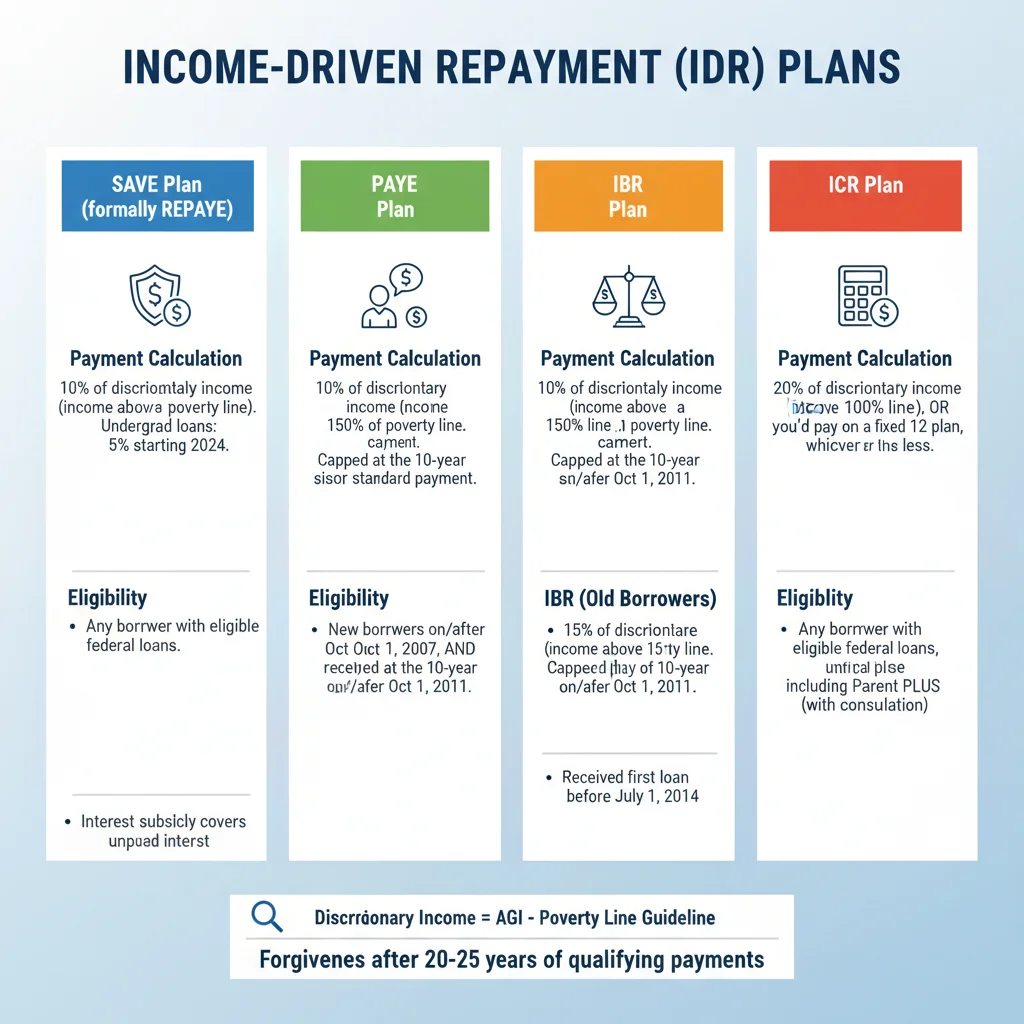
Here’s a quick overview of other federal IDR plans:
- Pay As You Earn (PAYE) Repayment Plan: Payments are generally 10% of your discretionary income, but never more than what you would pay under the Standard Repayment Plan. Forgiveness after 20 years of payments. Eligibility requires you to be a new borrower on or after October 1, 2007, and have received a disbursement of a Direct Loan on or after October 1, 2011.
- Income-Based Repayment (IBR) Plan: Two versions exist. For new borrowers on or after July 1, 2014, payments are 10% of discretionary income, with forgiveness after 20 years. For those who borrowed before July 1, 2014, payments are 15% of discretionary income, with forgiveness after 25 years. Payments are capped at the Standard Repayment Plan amount.
- Income-Contingent Repayment (ICR) Plan: Payments are calculated as the lesser of 20% of your discretionary income or what you would pay on a fixed 12-year repayment plan, adjusted by income. Forgiveness after 25 years. This is the only IDR plan available for Parent PLUS Loans that have been consolidated into a Direct Consolidation Loan.
Each of these plans has specific eligibility requirements and nuances. It’s highly recommended to use the Loan Simulator tool on StudentAid.gov to compare how your payments and total costs would differ under each plan. This tool is invaluable for making informed decisions about your student loan repayment 2026 approach.
Student Loan Forgiveness and Discharge Options for 2026
Beyond managing monthly payments, many borrowers dream of loan forgiveness. Several federal programs offer pathways to having your remaining loan balance discharged, and it’s essential to understand if you qualify for any of these as part of your student loan repayment 2026 strategy.
Public Service Loan Forgiveness (PSLF):
PSLF remains a cornerstone program for those working in public service. If you work full-time for a U.S. federal, state, local, or tribal government or a not-for-profit organization, you may be eligible for PSLF. After making 120 qualifying monthly payments (which do not have to be consecutive) under a qualifying repayment plan (typically an IDR plan, including SAVE), your remaining balance on Direct Loans can be forgiven tax-free. The key to PSLF success is ensuring you meet all requirements, including proper employment certification annually. Many borrowers who thought they didn’t qualify for PSLF in the past might find themselves eligible due to temporary waivers or updated rules, so it’s always worth re-evaluating your situation for student loan repayment 2026.
Teacher Loan Forgiveness:
Qualified teachers who work for five complete and consecutive academic years in a low-income school or educational service agency may be eligible for forgiveness of up to $17,500 on their Direct Subsidized and Unsubsidized Loans, and their Subsidized and Unsubsidized Federal Stafford Loans. This is a separate program from PSLF and has different requirements.
Total and Permanent Disability (TPD) Discharge:
If you become totally and permanently disabled, you may be eligible to have your federal student loans discharged. This can be based on documentation from the Department of Veterans Affairs, the Social Security Administration, or a physician. The discharge comes with a three-year monitoring period, during which certain income requirements must be met.
Borrower Defense to Repayment Discharge:
This program allows for the discharge of federal student loans if a school engaged in misconduct, such as misrepresenting job placement rates or program quality. If you believe your school defrauded you, you might be eligible for this discharge. The Department of Education has streamlined this process in recent years.
Closed School Discharge:
If your school closes while you are enrolled or soon after you withdraw, you may be eligible for a discharge of your federal student loans. This typically applies if you couldn’t complete your program due to the closure and didn’t transfer your credits to another school.
Other Forgiveness Opportunities:
Beyond federal programs, some states and specific professions offer their own loan repayment assistance programs (LRAPs). These often target critical need areas like healthcare, law, or STEM fields. Researching state-specific programs can uncover additional avenues for relief in your student loan repayment 2026 journey.
Proactive Strategies for Effective Student Loan Repayment in 2026
While federal programs provide a strong foundation, proactive personal strategies can further optimize your student loan repayment 2026 plan. Taking control of your debt involves more than just making monthly payments; it requires strategic thinking and consistent effort.
1. Understand Your Loan Details:
It sounds basic, but many borrowers don’t fully understand their loan types, interest rates, and servicers. Log into StudentAid.gov to view all your federal loans. Note whether they are Direct Loans, FFEL loans, or Perkins loans, as this affects eligibility for various programs. Knowing your interest rates will help you prioritize which loans to pay down faster if you make extra payments.
2. Re-evaluate Your Repayment Plan Annually:
Your income and family size can change, impacting your eligibility and payment amount under IDR plans. You must recertify your income and family size annually for IDR plans. Even if you’re on a fixed repayment plan, it’s wise to review all available options yearly, especially with ongoing changes in federal policy. This annual review is a critical component of successful student loan repayment 2026.
3. Consider Loan Consolidation:
Consolidating your federal student loans into a Direct Consolidation Loan can simplify your repayment by combining multiple loans into one with a single monthly payment. More importantly, consolidation can make older FFEL or Perkins loans eligible for IDR plans (like SAVE) and PSLF. Be aware that consolidation can sometimes extend your repayment period and may slightly increase your interest rate (it’s a weighted average of your previous rates, rounded up to the nearest one-eighth of a percentage). However, for many, the benefits of access to better programs outweigh these considerations.
4. Make Extra Payments Strategically:
If you have the financial capacity, making extra payments can significantly reduce the total interest paid and shorten your repayment period. When making extra payments, instruct your servicer to apply the additional amount to the principal of the loan with the highest interest rate. This is known as the ‘debt avalanche’ method and is generally the most cost-effective approach. Ensure your servicer doesn’t simply advance your due date without reducing principal.
5. Build an Emergency Fund:
Having an emergency fund (3-6 months of living expenses) is crucial. It provides a buffer if you face unexpected expenses or job loss, preventing you from missing loan payments and potentially defaulting. Financial stability is a key part of long-term student loan repayment 2026 success.
6. Avoid Student Loan Scams:
Be highly skeptical of companies promising immediate loan forgiveness or offering to enroll you in federal programs for a fee. The Department of Education and your loan servicers provide all necessary information and services for free. Legitimate assistance is available, but predatory companies often target vulnerable borrowers. Always go through official channels like StudentAid.gov or your assigned loan servicer.
7. Stay Informed About Policy Changes:
The landscape of student loans is dynamic. Follow reputable financial news sources, government announcements, and official Department of Education updates. Policy changes, even seemingly minor ones, can have a significant impact on your repayment strategy and potential savings. Being informed allows you to adapt your student loan repayment 2026 plan as needed.

Common Pitfalls to Avoid in Student Loan Repayment
Even with the best intentions, borrowers can fall into traps that hinder their progress. Avoiding these common pitfalls is just as important as implementing effective strategies for student loan repayment 2026.
Ignoring Your Loans:
The worst thing you can do is ignore your student loans. Defaulting on federal student loans has severe consequences, including wage garnishment, tax refund offset, and damage to your credit score. If you’re struggling, contact your servicer immediately to discuss options like deferment, forbearance, or an IDR plan.
Not Recertifying IDR Plans on Time:
If you’re on an IDR plan, you must recertify your income and family size annually. Failing to do so can result in your payments reverting to the Standard Repayment Plan amount, potentially leading to a higher payment and capitalized interest (unpaid interest added to your principal balance).
Paying Only the Minimum on High-Interest Loans:
While IDR plans aim to make payments affordable, if you have the capacity, paying only the minimum, especially on loans with higher interest rates, can mean you pay significantly more over time. Strategically targeting higher-interest loans with extra payments can save thousands.
Falling for Scams:
As mentioned, loan scams are prevalent. Never pay for services that are free through your loan servicer or the Department of Education. Be wary of unsolicited calls, emails, or social media messages promising quick fixes for your loans.
Not Understanding Consolidation Implications:
While consolidation is beneficial for many, it’s not always the right choice. For example, consolidating Perkins Loans might mean losing specific forgiveness benefits associated with those loans. Always research and understand the full implications before consolidating.
Looking Ahead: What Else Might Impact Student Loan Repayment in 2026?
The political and economic climate can significantly influence student loan policies. While the SAVE Plan and existing IDR options provide a stable framework for student loan repayment 2026, it’s always wise to anticipate potential future changes.
Discussions around further student loan reform, including potential changes to the Higher Education Act, could introduce new programs or modify existing ones. While large-scale, across-the-board forgiveness remains a topic of debate, targeted relief efforts are more common. Staying connected to official government sources and reputable financial news outlets will help you adapt your strategy to any new developments.
Additionally, economic factors such as inflation, interest rate changes, and employment rates can indirectly affect your ability to repay loans. A strong job market might mean more disposable income for extra payments, while economic downturns could necessitate a reliance on IDR plans or deferment. Planning for different scenarios can provide peace of mind in your student loan repayment 2026 journey.
Conclusion: Empowering Your Student Loan Repayment Journey in 2026
Navigating student loan repayment 2026 can seem daunting, but with the right knowledge and proactive strategies, you can significantly reduce your financial burden and work towards debt freedom. The federal government has introduced powerful tools like the SAVE Plan and various forgiveness programs designed to help borrowers. Your task is to understand these options, assess your eligibility, and apply the strategies that best fit your personal and financial circumstances.
Take the time to review your loan portfolio, utilize the resources available on StudentAid.gov, and communicate openly with your loan servicer. By staying informed, making strategic decisions, and avoiding common pitfalls, you can save thousands of dollars and achieve greater financial stability in your student loan repayment 2026 and beyond. Remember, you don’t have to tackle this alone; help and information are readily available to guide you on your path to managing student debt effectively.